CPL vs CPQL vs CAC vs ROAS: four formulas, one funnel, a worked example
Sardor Rakhmonkulov7 min read
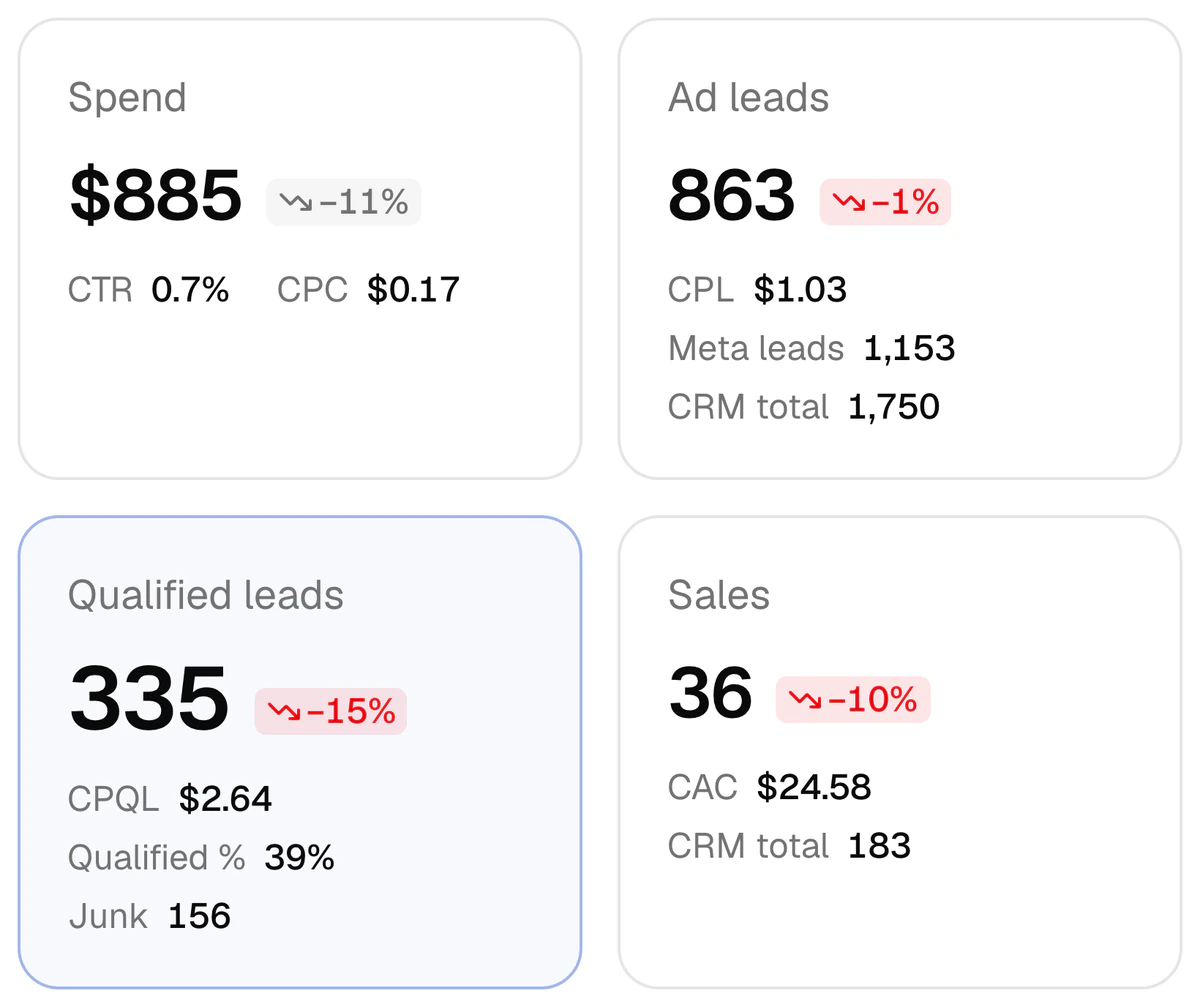
CPL is cost per lead: spend ÷ leads. CPQL is cost per qualified lead: spend ÷ qualified leads. CAC is customer acquisition cost: spend ÷ sales. ROAS is revenue ÷ spend. In one week a driving school spent $885 and got 863 leads, 335 qualified leads, 36 sales and $5,297 of revenue recorded in the CRM: CPL $1.03, CPQL $2.64, CAC $24.58, ROAS 5.99×.
In short
- CPL, CPQL and CAC are the same spend divided by leads, by qualified leads and by sales. ROAS turns the ratio round: revenue ÷ spend.
- A driving school, 2–8 October 2026: CPL $1.03, CPQL $2.64, CAC $24.58, ROAS 5.99×, all from the same $885.
- Cost per lead misleads on its own: a creative with $0.87 leads made no sales, and one with $1.28 leads made five.
- The ad account shows CPL by itself; CPQL, CAC and ROAS need the stages and deal amounts from the CRM.
- ROAS is counted on revenue recorded in the CRM: when a manager leaves the deal amount empty, it comes out lower than it really is.
CPL, CPQL, CAC and ROAS are usually explained one at a time. In practice they are four points on one funnel: money is spent, a lead arrives, the lead proves qualified, a sale is made. Here is a worked example with all four formulas on one week of one project: a driving school advertising on Meta (Facebook and Instagram), 2–8 October 2026.
The week’s inputs: $885 of spend, 863 leads, 335 qualified leads, 36 sales and $5,297 of revenue recorded in the CRM. All four metrics come from these five numbers.
What is CPL, and how is cost per lead calculated?
CPL = ad spend ÷ number of leads
Example: $885 ÷ 863 leads = $1.03
CPL measures what it costs the ads to get one person to leave a request. It is a number about the advertising itself: does the creative catch attention, is the form easy to fill in, is the audience expensive. Ads Manager shows it by itself, so a media buyer’s report usually opens with it.
CPL does not show who the lead is: a real buyer and someone who filled in the form out of boredom cost the same.
What is CPQL, and how is cost per qualified lead calculated?
A qualified lead is a lead the sales team has spoken to and confirmed as a real prospect: in the CRM it has reached the stage that carries this meaning. Which stage counts as “qualified” is each business’s own decision.
CPQL = ad spend ÷ number of qualified leads
Example: $885 ÷ 335 qualified leads = $2.64
Of the 863 leads, 335 turned out qualified: 39%. So CPQL is 2.6 times the cost per lead: not $1.03 but $2.64. It tells whether the ads bring the right people.
CPQL is known long before the sale: once a manager has spoken to the lead and moved its stage. That makes it the fairest number for a new creative’s first week. If the definition of a qualified lead changes, CPQL changes too: agree on it once and leave it alone.
How is CAC calculated?
CAC = ad spend ÷ number of sales
Example: $885 ÷ 36 sales = $24.58
The week had 36 sales against 335 qualified leads: 11%. One customer cost $24.58, the price of 24 leads. CAC is the business owner’s number: it is set against the profit one customer brings. If the profit is above CAC, the advertising pays; if below, it loses money, however cheap the lead.
Here CAC holds ad spend only. A full CAC adds the media buyer’s or agency’s fee, the sales team’s pay and the tools. Ad-spend CAC is enough to compare creatives and campaigns; the economics of the business need the full one.
What is ROAS, and how is it calculated?
ROAS = revenue from ads ÷ ad spend
Example: $5,297 ÷ $885 = 5.99×
A ROAS of 5.99× means that every $1 of advertising has $5.99 of revenue recorded against it in the CRM. ROAS is not profit: cost of goods, rent and salaries are not in it. At a 50% margin, a ROAS of 2× only just covers the ad spend.
The second weak spot is revenue itself: in the report it is the amounts written into CRM deals. When a manager leaves the amount empty, the sale is counted, nothing is added to revenue, and ROAS comes out lower than it really is. At this driving school managers enter about half of the amounts, so 5.99× is ROAS on recorded revenue.
CPL vs CPQL vs CAC vs ROAS: what is the difference?
| Metric | That week | What it measures | Who watches it | What you decide by it |
|---|---|---|---|---|
| CPL, cost per lead | $1.03 | What one request costs the ads | The media buyer, in Ads Manager | Do the creative and the form work? If leads get dearer, find the cause |
| CPQL, cost per qualified lead | $2.64 | What a real prospect costs | The media buyer and the head of sales, with the CRM | Stop creatives with no qualified leads; add budget to those that bring them |
| CAC, customer acquisition cost | $24.58 | What one paying customer costs | The business owner, the head of marketing | Scale the ads or cut them, by the profit a customer brings |
| ROAS, return on ad spend | 5.99× | Revenue brought back by each $1 spent | The business owner, finance | Split the budget between campaigns; do the ads pay for themselves? |
Each row down is a step closer to the money and is known a step later: CPL the same day, CPQL after the manager’s call, CAC and ROAS after the payment.
Why is cost per lead misleading on its own?
Because CPL is an average and sees only the first step of the funnel. Two creatives of the same driving school, same week:
| First creative | Second creative | |
|---|---|---|
| Leads | 79 | 77 |
| Cost per lead (CPL) | $0.87 | $1.28, 47% dearer |
| Sales | 0 | 5 |
| Verdict by CPL | The “best” ad | An expensive ad |
| Verdict by sales | Not one customer in the week | The ad that sells |
A media buyer who looks only at cost per lead adds budget to the first creative and switches off the second: the ad that sells. In the same week 23 creatives spent $386 without a single sale, 44% of the budget.
Quality can differ even at the same lead price. At a learning centre (2–8 October 2026) two creatives had almost the same cost per lead, $2.79 and $2.97: none of the first one’s 14 leads was qualified, 18 of the second one’s 24 were. In the same project a qualified lead cost $2.20 in one creative and $71.40 in another, a 32-fold gap. More in which ad creative sells.
Where does each number come from: the ad account or the CRM?
The four formulas hold five numbers. One comes from the ad account, the rest from the CRM.
| Number | Where it comes from | What to watch |
|---|---|---|
| Spend: $885 | The Meta ad account (Ads Manager) | Ads in dollars, CRM in so‘m: revenue is converted into the currency of the spend |
| Leads: 863 | Ads Manager counts submitted forms; the CRM counts records | Two requests from one person are two CRM records. Count people, not rows |
| Qualified leads: 335 | The CRM: a manager moves the lead to the “qualified” stage | A stage changed late makes CPQL late |
| Sales: 36 | The CRM: the deal moves to the sale stage | The ad behind a sale is known only if the lead is tied to its ad |
| Revenue: $5,297 | The CRM: the amount written into the deal | No amount means an understated ROAS |
So CPL can be worked out from the ad account alone. For CPQL, CAC and ROAS you have to know which ad each CRM lead came from. With lead forms and website requests the sale is closed in the CRM, outside the advertising, and Meta does not see it by itself: that week, on its own, it saw 863 leads and none of the 36 sales.
There are two ways to join the two sides. One is a report: the CAPI Platform report puts Meta’s spend and the CRM’s outcome (Bitrix24, amoCRM or capiCRM) on one row for every creative. The other is sending the outcome back to Meta: a CRM stage goes through the Conversions API as a custom event named QualifiedLead or as a Purchase event.
Meta reports that advertisers who used the Conversions API for CRM and optimised instant forms for the number of qualified leads saw a 19% lower cost per quality lead on average (a budget-controlled A/B test, 567 advertisers, 13–27 January 2025). That is Meta’s test, not a result of CAPI Platform.
What do you do with these four numbers each week?
- 1
Compare CPL with last week
If leads suddenly got dearer, look for the cause in the creative, the audience or the form. Never switch a creative off on CPL alone: it warns, it does not pass sentence.
- 2
Sort creatives by CPQL
Stop those that spend money and bring no qualified leads. If the qualified share is low, ask the advertising: who is it bringing?
- 3
Set CAC against the profit per customer
Many qualified leads and few sales is a question for the sales team. If CAC is below the profit, add budget to the creatives that sell.
- 4
Check the amounts before ROAS
How many sales have no amount? Fill those in first, then split the budget between campaigns by ROAS.
See these four numbers for your own ads
CAPI Platform works out spend → lead → qualified lead → sale for every creative by itself. Sign up with Google and connect Meta and your CRM yourself, or leave a request and we will set it up in 3 days. Set-up is $159 once, then $40 a month.
FAQ
What is a good cost per lead?
There is no single norm: it depends on the trade, the price of the product and the sales team. The right ceiling comes from your own funnel: divide the CAC you can afford by the number of leads one sale takes. The driving school had 36 sales against 863 leads in the week, about 24 leads per sale. With a CAC ceiling of $24, for example, a lead should cost no more than $1.
What is a good ROAS?
It depends on your margin. The point where ad spend is covered is 1 ÷ the margin share: 2× at a 50% margin, 4× at 25%. Anything above that is money left after advertising. That is why the same ROAS is an excellent result for one business and a loss for another.
What is the difference between ROAS, ROI and ROMI?
ROAS divides revenue by ad spend and is written as a multiple: 5.99×. ROI and ROMI are counted from profit: (profit − cost) ÷ cost, as a percentage. ROAS needs only revenue and ad spend; ROMI also needs the cost of goods and the rest of the marketing costs.
Can I see CPQL in Ads Manager?
Not by itself: Ads Manager does not know which lead turned out qualified. When the CRM stage is sent to Meta through the Conversions API as a custom event named QualifiedLead, a custom conversion is created from it in Ads Manager and the ads can be optimised for that result. In the CAPI Platform report CPQL stands beside every creative.
Can I calculate CPL, CPQL, CAC and ROAS in a spreadsheet?
Yes. Take spend per ad from Ads Manager and the list of leads with stage and amount from the CRM. The hard part is tying each lead to its ad: the CRM has to hold the Meta lead ID, or the ad’s ID in a UTM tag of the ad link. CAPI Platform does this matching itself and merges one person’s repeat leads by phone.
Sources
- 1Conversions API for CRM — Meta
- 2Conversion Leads integration — Meta for Developers
Read next
- Lead quality
Cheap Facebook leads but no sales: why low-quality leads happen and how to fix them
Why a cheap lead does not sell: two creatives from a real report, causes on three sides and a seven-step fix.
7 min read
- Creative analysis
Which ad creative actually drives sales? Reading a Meta ads report by sales, not cost per lead
Reading a per-creative table by sales: a real pair (79 leads, 0 sales vs 77 leads, 5 sales), a waiting rule and a weekly routine.
7 min read
- Reporting
How to evaluate a media buyer’s Meta ads report: what it must contain, with a worked week
What the report must contain, what to ask every week and what is fair to expect from a media buyer, shown on one real week.
7 min read