CAC (customer acquisition cost)
CAC (customer acquisition cost) is what it costs to win one customer: spend divided by the number of sales in the same period. Ad-spend CAC holds ad spend only; a full CAC adds the other marketing and sales costs.
Also written: CAC, customer acquisition cost, cost of customer acquisition, cost per customer, cost per sale, CAC formula, CAC meaning
What is CAC, and what does it measure?
CAC is the business owner’s number: what one paying customer cost. It is set against the profit that customer brings. If the profit is above CAC, the advertising pays; if below, it loses money, however cheap the lead.
How is CAC calculated?
CAC = ad spend ÷ number of sales
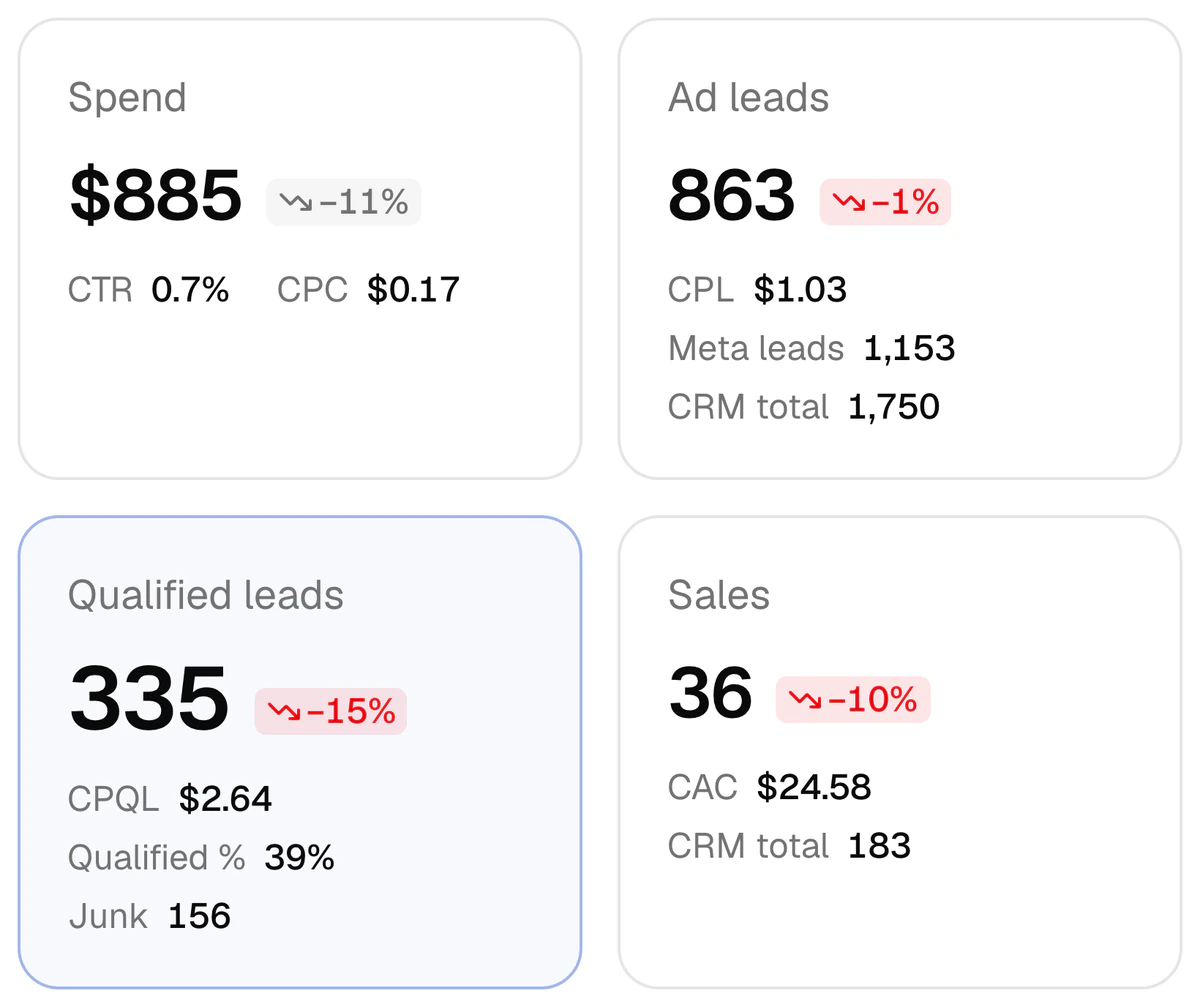
Example: A driving school, 2–8 October 2026: $885 ÷ 36 sales = $24.58.
One customer cost as much as 24 leads. This CAC holds ad spend only. A full CAC adds the media buyer’s or agency’s fee, the sales team’s pay and the tools. Ad-spend CAC is enough to compare creatives; the economics of the business need the full one.
Where does the number of sales come from?
From the CRM. When ads lead to a lead form, the sale is closed outside the ad account: that week Meta on its own saw 863 leads and none of the 36 sales. CAC per creative needs every sale tied to its ad: CAPI Platform takes the sale from a CRM stage (Bitrix24, amoCRM or capiCRM) and ties it to the ad the lead came from. In the same week 23 creatives spent $386 (44% of the budget) without a single sale, so they have no CAC to calculate at all.
FAQ
What is a good CAC?
There is no single norm. CAC has to stay below the profit one customer brings: the profit of that sale if people buy once, or of the whole time they keep buying (LTV) if they come back. That is why the same CAC is an excellent result for one business and a loss for another.
What is the difference between CAC and CPL?
CPL is the cost of one request; CAC is the cost of one customer who paid. In the driving school’s week (2–8 October 2026) CPL was $1.03 and CAC $24.58: one sale took about 24 leads. A cheap lead is not a cheap customer: the creative with leads at $0.87 brought no sales that week.
Can you see CAC in Ads Manager?
Not by itself when the sale is closed in the CRM: Meta does not see it. Once the sale stage is sent from the CRM through the Conversions API as a Purchase event, Meta learns of the sale. In the CAPI Platform report CAC stands beside every creative: spend → lead → qualified lead → sale.
Related terms and pages
- CPL (cost per lead)CPL (cost per lead) is what one lead costs: ad spend divided by the number of leads in the same period. It shows what the ads pay to get one request, and says nothing about whether that lead will ever buy.
- CPQL (cost per qualified lead)CPQL (cost per qualified lead) is what one qualified lead costs: ad spend divided by the number of leads the sales team has confirmed as qualified in the CRM. Unlike cost per lead (CPL), it counts only the people who passed qualification, not every submitted form.
- ROAS (return on ad spend)ROAS (return on ad spend) is the revenue that advertising brought, divided by what the advertising cost. A ROAS of 5.99× means every $1 of ad spend came back as $5.99 of revenue, not profit.
- Sales funnelA sales funnel is the sequence of stages a person goes through from first seeing an ad to paying; fewer people remain at each stage, hence the name. In a CRM the funnel, or pipeline, is the list of stages a lead or a deal moves through.
- CPL vs CPQL vs CAC vs ROAS: four formulas, one funnel, a worked exampleFour metrics, four formulas and one real week: $885 of spend → 863 leads → 335 qualified leads → 36 sales.
- Which ad creative actually drives sales? Reading a Meta ads report by sales, not cost per leadReading a per-creative table by sales: a real pair (79 leads, 0 sales vs 77 leads, 5 sales), a waiting rule and a weekly routine.
- ReportSee which Meta ad drives sales: spend, leads, qualified leads, sales, CAC and ROAS for every creative, with outcomes from Bitrix24, amoCRM or capiCRM.
Updated:
We set CAPI up in 3 days
$159 once, then $40 a month. Lead integration is included.