CPL (cost per lead)
CPL (cost per lead) is what one lead costs: ad spend divided by the number of leads in the same period. It shows what the ads pay to get one request, and says nothing about whether that lead will ever buy.
Also written: CPL, cost per lead, cost-per-lead, lead cost, price per lead, CPL formula, CPL meaning
What is CPL, and what does it measure?
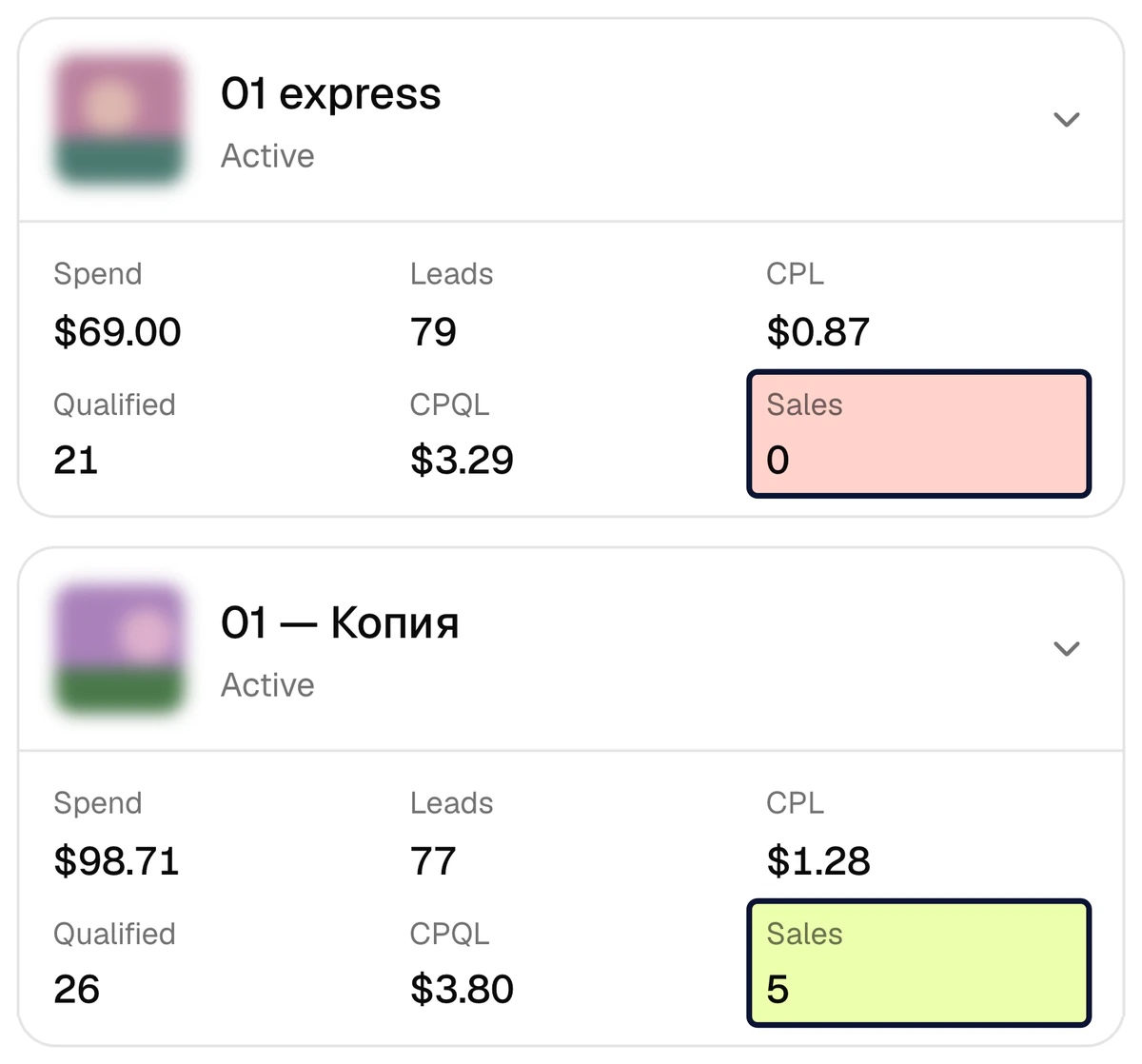
CPL is a number about the advertising itself: does the creative catch attention, is the form easy to fill in, is the audience expensive. Ads Manager shows it by itself (in a lead campaign it is the Cost per result column), so a media buyer’s report usually opens with it. CPL does not know who the lead is: a real buyer and someone who filled in the form out of boredom cost the same.
How is CPL calculated?
CPL = ad spend ÷ number of leads
Example: A driving school, 2–8 October 2026: $885 ÷ 863 leads = $1.03.
Take spend and leads from the same period. Two things distort the result: repeat requests from one person (count people, not rows) and leads that did not come from ads, which are not divided into ad spend. In the CAPI Platform report CPL is calculated only on leads tied to a specific ad, separately for every creative.
Example: two projects, two different lead costs
| Project | Period | Spend | Leads | CPL |
|---|---|---|---|---|
| Driving school | 2–8 Oct 2026 | $885 | 863 | $1.03 |
| Driving school | 9 Sep – 8 Oct 2026 | $4,528 | 4,221 | $1.07 |
| Learning centre | 2–8 Oct 2026 | $2,470 | 685 | $3.61 |
| Learning centre | 9 Sep – 8 Oct 2026 | $9,085 | 2,393 | $3.80 |
Inside one project the weekly and the 30-day CPL are almost the same; between the two projects the gap is more than threefold. So compare CPL with your own previous period and between your own creatives, not with another business. If leads suddenly get dearer, look for the cause inside the ads: the creative, the audience, the form.
FAQ
What is a good CPL?
There is no single norm: it depends on the trade, the price of the product and the sales team. The ceiling comes from your own funnel: divide the CAC you can afford by the number of leads one sale takes. In one week (2–8 October 2026) the driving school needed about 24 leads per sale: 863 leads, 36 sales. With a CAC ceiling of $24, for example, a lead must not cost more than $1.
Why does CPL in Ads Manager differ from CPL counted in the CRM?
Because a lead is counted differently. Ads Manager counts every submitted form; a CRM counts every record, so a person who sends two requests is usually two records. The CAPI Platform report counts people: repeat requests from one phone number are one lead.
What is the difference between CPL and CPQL?
CPL counts every lead; CPQL counts only those the sales team has confirmed as qualified in the CRM. In the driving school’s week (2–8 October 2026) CPL was $1.03 and CPQL $2.64: 335 of 863 leads (39%) were qualified.
Related terms and pages
- LeadA lead is a person who has shown interest in a product or service and left contact details, usually a phone number, so the business can reach them. A lead is not yet a customer: it becomes a sale only after the sales team follows up and closes.
- CPQL (cost per qualified lead)CPQL (cost per qualified lead) is what one qualified lead costs: ad spend divided by the number of leads the sales team has confirmed as qualified in the CRM. Unlike cost per lead (CPL), it counts only the people who passed qualification, not every submitted form.
- CAC (customer acquisition cost)CAC (customer acquisition cost) is what it costs to win one customer: spend divided by the number of sales in the same period. Ad-spend CAC holds ad spend only; a full CAC adds the other marketing and sales costs.
- ROAS (return on ad spend)ROAS (return on ad spend) is the revenue that advertising brought, divided by what the advertising cost. A ROAS of 5.99× means every $1 of ad spend came back as $5.99 of revenue, not profit.
- CPL vs CPQL vs CAC vs ROAS: four formulas, one funnel, a worked exampleFour metrics, four formulas and one real week: $885 of spend → 863 leads → 335 qualified leads → 36 sales.
- Cheap Facebook leads but no sales: why low-quality leads happen and how to fix themWhy a cheap lead does not sell: two creatives from a real report, causes on three sides and a seven-step fix.
- ReportSee which Meta ad drives sales: spend, leads, qualified leads, sales, CAC and ROAS for every creative, with outcomes from Bitrix24, amoCRM or capiCRM.
Updated:
We set CAPI up in 3 days
$159 once, then $40 a month. Lead integration is included.