Skip to content
Cases · results

Meta Conversions API case studies for lead generation

This page keeps two kinds of Meta Conversions API (CAPI) results apart. First, readings from the report of two lead generation projects connected to CAPI Platform (capip.uz): a driving school and a learning centre, over 7 and 30 days. Second, case studies published by Meta and by integration vendors, each linked to its source. The first is what our report showed; the second is other companies’ own results.

  • Driving school, 7 days: $885 spent, 863 leads, 36 sales
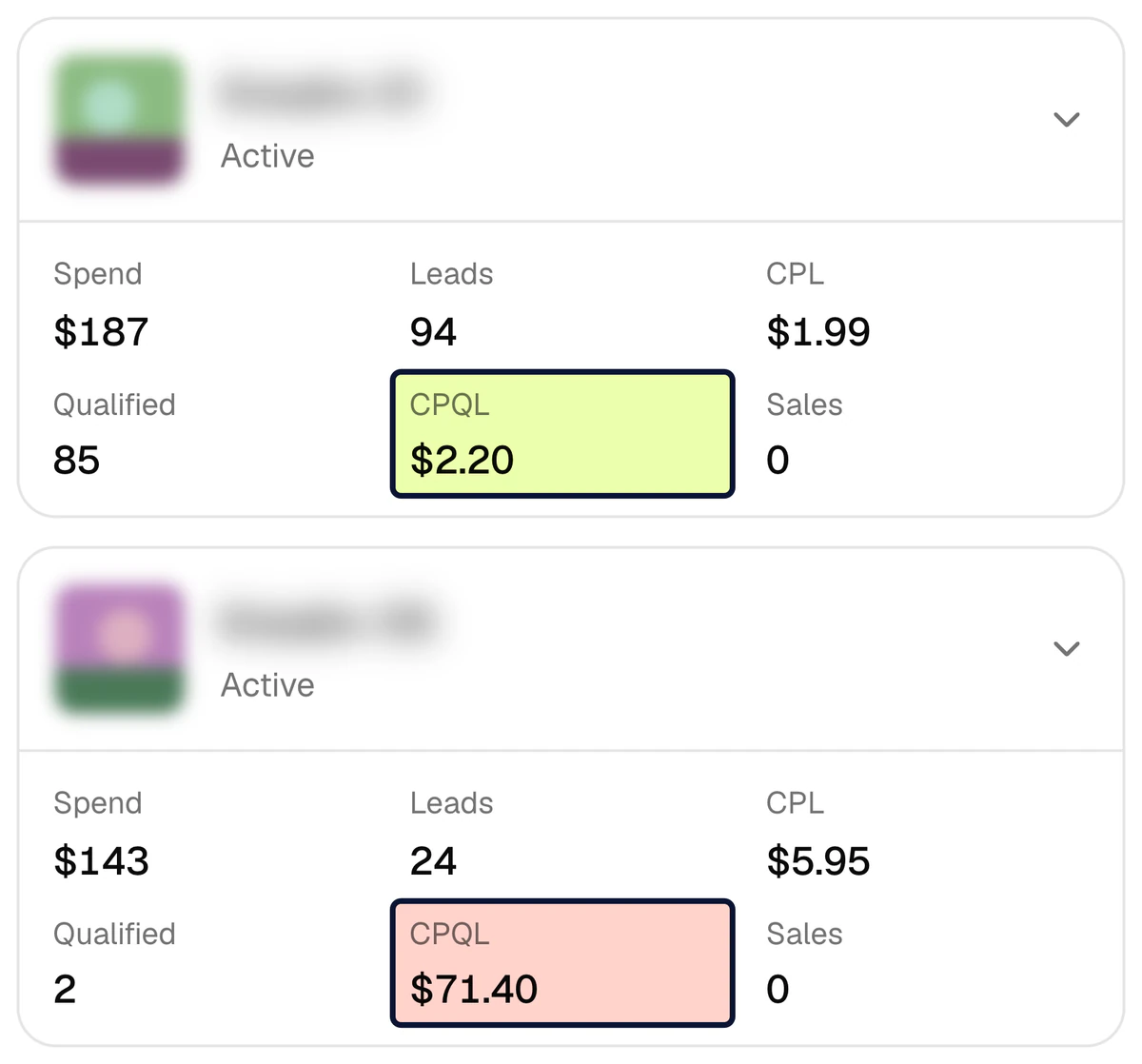
  • Learning centre: a qualified lead at $2.20 in one creative, $71.40 in another
  • 2,103 Meta leads delivered into the CRM, none lost
  • 6 published case studies and 3 Meta statistics, each with its source
ad spend in the reporttwo projects, 9 September – 8 October 2026
$13,613
CRM leads in the reportin 30 days
15,613
qualified leads
2,978
Meta leads delivered into the CRMnone lost as of 8 October 2026
2,103
Our projects · 2–8 October 2026

One week, two projects: what the report showed

The projects are named only by their trade; the names are withheld. The figures come from the CAPI Platform report: spend from Meta; leads, qualified leads and sales from the CRM. They are one week’s readings, not a before-and-after effect of connecting the Conversions API.

2–8 October 2026 · 7 days

Driving school

In one week $885 of spend brought 863 leads; 335 of them were qualified and 36 became sales. Revenue recorded in the CRM was $5,297, a ROAS of 5.99×.

ad spend
$885
ad leadsCPL $1.03
863
qualified leads39% · CPQL $2.64
335
salesCAC $24.58
36
  • One creative brought leads at $0.87 each: 79 leads, 0 sales. Another cost $1.28 a lead (47% more): 77 leads, 26 qualified, 5 sales.
  • 23 creatives spent $386, or 44% of the budget, without a single sale.
  • One customer cost $24.58, about the price of 24 leads.
  • Meta counted 863 leads that week; the 36 sales were closed in the CRM, and Meta learns of a sale only if the CRM tells it.
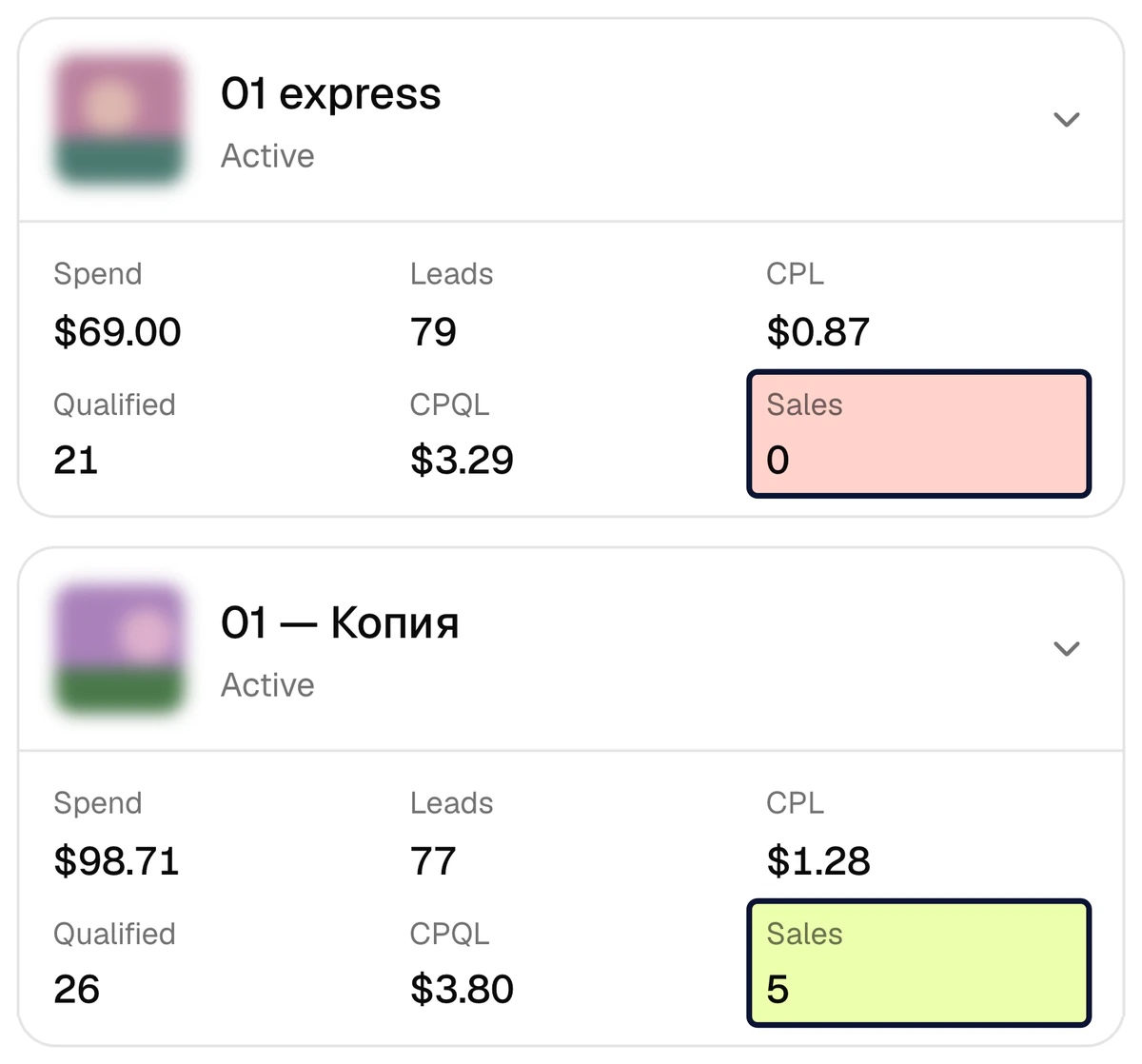
Two creatives in the report: one with 79 leads at $0.87 each and 0 sales, the other with 77 leads at $1.28 each and 5 sales.
2–8 October 2026 · 7 days

Learning centre

$2,470 of spend brought 685 leads: 330 qualified and 134 junk, with 18 sales. The gap here showed up not in the cost per lead but in the cost per qualified lead.

ad spend
$2,470
ad leadsCPL $3.61
685
qualified leads48% · CPQL $7.49
330
sales
18
  • A qualified lead cost $2.20 in one creative and $71.40 in another, a 32-fold gap. In Ads Manager both are simply “a lead”.
  • Two creatives with almost the same cost per lead, $2.79 and $2.97: none of the first one’s 14 leads was qualified, while 18 of the second one’s 24 were.
  • 134 of the 685 leads were junk, almost one in five.
Two creatives in a learning centre's report: a qualified lead costs $2.20 in one (85 qualified of 94 leads) and $71.40 in the other (2 of 24).
30 days · 9 September – 8 October 2026

The 30-day numbers: driving school and learning centre

One week can be a fluke, so here are 30 days beside it. From the same report, as of 8 October 2026.

MetricDriving schoolLearning centre
Ad spend$4,528$9,085
Ad leads4,2212,393
Cost per lead (CPL)$1.07$3.80
Qualified leads1,840 (44%)1,138 (48%)
Sales183118
Meta leads delivered into the CRM1,790 (since 25 September)313 (since 5 October)

The learning centre’s cost per qualified lead (CPQL) over the 30 days was $7.98. Both projects together: $13,613 of ad spend, 15,613 CRM leads in the report (including leads that did not come from ads) and 2,978 qualified leads. Do not compare the two projects with each other: the trade, the price of a sale and the sales cycle differ. Each is compared with its own previous period.

Revenue

Revenue: the figure recorded in the CRM, and the estimate beside it

Revenue in the report is the sum of the amounts recorded in CRM deals. A sale with no amount still counts as a sale but adds nothing to revenue. So recorded revenue can be lower than the real figure.

Driving school, 30 daysRevenueROASWhere the figure comes from
Recorded in the CRM$26.2 thousand5.79×The report’s reading
Real revenue, an estimate≈ $52.4 thousand≈ 11.6×The managers enter about half of the deal amounts
Lead delivery

2,103 Meta leads delivered into the CRM, none lost

Leads from Meta lead forms reach the CRM through the platform. The measurement for both projects, as of 8 October 2026:

leads, driving schoolsince 25 September 2026
1,790
leads, learning centresince 5 October 2026
313
lost
0
in the queueerrors: 0
0

This is a measurement for the stated dates, not a guarantee. How it works: lead delivery.

Published by others

When outcomes go back to Meta: 6 published case studies

On its own, Meta saw 863 leads in the driving school’s week and none of the 36 sales. What changes when outcomes are sent back to Meta, whether from a CRM, a point of sale or a server, has been measured and published by others. The six results below are not CAPI Platform’s: four are lead generation with a CRM, two are retail. Each figure is given as its source reports it, with a link.

A/B test · Meta Blueprint lesson dated 14 July 2022

TECOBI — automotive dealer marketing, US

Meta reports that with the CRM connected through the Conversions API and the campaign optimised for conversion leads rather than lead volume, the conversion rate was 68% higher and the cost per qualified lead 8% lower.

  • Two cells: one optimised for lead volume, the other for conversion leads with the CRM integrated through the Conversions API.
  • Creative, format and targeting were identical in both.
  • The source is Meta’s own case study, inside a Meta Blueprint lesson.

Source: Generate high-quality leads (the lesson with the TECOBI case study) — Meta Blueprint

conversion rateagainst lead-volume optimisation
+68%
cost per qualified lead
−8%
8–30 May 2024

Univo — online degrees, India

Datahash reports that after down-funnel CRM events were sent to Meta, the lead-to-enrolment rate was about 3× higher and the cost per enrolment about 2× lower.

  • Meta optimised delivery for enrolments rather than lead volume (Conversion Leads Optimisation).
  • The comparison is with business as usual.
  • The figures are client metrics shared with Meta; the page is hosted by the integration partner.

Source: Univo case study — Datahash

higher lead-to-enrolment rate
~3×
lower cost per enrolment
~2×
Published 18 July 2024

Volkswagen UK — automotive, United Kingdom

Driftrock reports that once confirmed test-drive bookings became the signal for Meta, 65% of raw leads converted to a booked test drive, which the case study calls “over 3 times more efficient”.

  • The signal was a confirmed test-drive booking; the campaign ran on Conversion Leads Optimisation.
  • Agency: PHD. Integration: Driftrock, through what the case study calls the Offline Conversions API.
  • No baseline is published: the case study does not say what level the 65% rose from.

Source: Volkswagen UK case study — Driftrock

of raw leads booked a test drive
65%
“more efficient”, in the case study’s words
> 3×
Undated

Orange — telecom, Spain

Walmeric reports that after CRM and call-centre data were connected to Meta and Lead Ads moved to a new conversion objective, the conversion rate rose 35% against regular campaigns and the cost per qualified lead fell 5%.

  • CRM and call-centre outcomes were sent through the Facebook Offline Conversions API.
  • The case study gives neither a date nor a test design.

Source: Orange success story — Walmeric

conversion rateagainst regular campaigns
+35%
cost per qualified lead
−5%
2025: January–April against April–July

Raymond Lifestyle — fashion retail, India

A case study in Meta’s partner directory reports that after point-of-sale transactions were fed to Meta, combined online and offline ROAS rose 3.2× and the cost per offline purchase fell by about 80%.

  • Integration by Datahash: point-of-sale transactions through the Offline Conversions API.
  • A before-and-after comparison: the period before activation against the period after, measured in Ads Manager.
  • Meta’s note: the metrics were supplied by the client, and results vary.

Source: Raymond Lifestyle case study (Datahash) — Meta partner directory

increase in combined ROASonline + offline
3.2×
lift in offline ROAS
1.9×
lower cost per offline purchase
~80%
2024

Ipekyol — women’s fashion, Turkey

A case study in Meta’s partner directory reports that after the Conversions API was added to the Pixel, the cost per purchase fell 45%, purchases rose 58% and ROAS rose 92%.

  • The reason given: privacy rules had cut tracked events by 50%.
  • Integration by AnalyticaHouse.
  • Meta’s note: the metrics were supplied by the client, and results vary.

Source: Ipekyol case study (AnalyticaHouse) — Meta partner directory

cost per purchase
−45%
purchases
+58%
ROAS
+92%
Meta’s statistics

What Meta measured in its own tests

Three figures, three separate measurements. They do not add up, and none is a forecast for a single ad account.

lower cost per quality lead, on averageConversions API for CRM with optimisation for the number of qualified leads on instant forms. A budget-controlled A/B test, 567 advertisers, 13–27 January 2025.
19%
higher lead-to-quality-lead rate, on averageA/B tests, 273 advertisers, 11–28 January 2024, 95% confidence; incentives were included, per Meta’s footnote.
44%
lower cost per result, on averageAdvertisers with the Conversions API set up for web events, against those without. Meta, 15 April 2026; no sample or period is published.
17.8%

These are averages across many advertisers, not CAPI Platform’s results. The links are under Sources.

Weight of evidence

How to read these numbers

Not every case study carries the same weight. Before trusting a figure, check how it was measured.

Kind of measurementWhat it showsOn this page
A/B test: two cells at the same timeThe effect of the change itself, with everything else equalTECOBI; Meta’s tests behind the 19% and 44% figures
Before and after: two periodsA change, though season, budget and creatives may have changed tooRaymond Lifestyle
Against regular campaignsA difference; the test design is not fully describedUnivo, Orange
A figure with no baselineThe level reached, not the liftVolkswagen UK
A report readingWhat happened in one project in one periodThe driving school and the learning centre

The Ipekyol and Raymond Lifestyle case studies sit in Meta’s partner directory with Meta’s note that the metrics are client-supplied and results vary. Our two projects are report readings: this page has no figure of our own that measures a before-and-after effect of the Conversions API.

How the numbers are counted

How are leads, qualified leads and sales counted in these cases?

Every figure comes from the CAPI Platform report. A lead is a person who reached the CRM and is tied to a specific ad; a qualified lead is one who reached the stage marked “qualified lead” in the CRM; a sale is a deal that moved to a sale stage. The report counts people, not rows: repeat leads from one person are merged by phone. Spend comes from Meta. CPL, CPQL and CAC are spend divided by those counts: see the formulas.

How is revenue counted, and why is there an estimate beside it?

Revenue in the report is the sum recorded in CRM deals: for the driving school, $26.2 thousand over 30 days (ROAS 5.79×). Its managers enter about half of the amounts, so we estimate real revenue at about $52.4 thousand (ROAS about 11.6×). The report does not show that estimate, which is why it always stands beside the recorded figure and the reason.

Are these results caused by the Conversions API? Will mine look the same?

No, and we do not claim that. Our two projects’ figures are what the report showed for a period: which creative brought sales and where the budget went. They are not a before-and-after effect and not a promise of results. What changes when outcomes go back to Meta has been measured by Meta and other companies; their figures are listed separately, with sources. Your result depends on your trade, the price of a sale, your sales team and your creatives.

What does “none lost” mean?

From the moment the forms were switched on until 8 October 2026, every lead Meta handed over was written to the CRM: 1,790 at the driving school since 25 September and 313 at the learning centre since 5 October, 2,103 in all. Queue 0, errors 0. It is a measurement for those dates, not a guarantee: if a lead fails to write, the platform retries from 1 minute up to 24 hours, and a lead that has waited 15 minutes raises a Telegram alert when alerts are switched on.

Sources

The driving school’s and the learning centre’s figures come from the CAPI Platform report as of 8 October 2026; project names are withheld. The outside case studies and statistics come from the pages below.

  1. 1Generate high-quality leads (the TECOBI case study) — Meta Blueprint
  2. 2Univo case study — Datahash
  3. 3Volkswagen UK case study — Driftrock
  4. 4Orange success story — Walmeric
  5. 5Raymond Lifestyle case study (Datahash) — Meta partner directory
  6. 6Ipekyol case study (AnalyticaHouse) — Meta partner directory
  7. 7Conversions API for CRM (the tests behind 19% and 44%) — Meta
  8. 8Removing Technical Barriers to Help Businesses of All Sizes Get More From Their Ads (17.8%) — Meta

See your own numbers the same way

Sign up with Google and connect Meta and your CRM yourself, or leave a request and we will set it up in 3 days. Set-up is $159 once, then $40 a month.