amoCRM (Kommo) and the Meta Conversions API: lead forms in, pipeline stages back
CAPI Platform (capip.uz) connects amoCRM (Kommo) with Meta ads on Facebook and Instagram, both ways. A lead-form lead lands in the CRM as a deal with a contact. When the deal reaches your qualified-lead or sale stage, a QualifiedLead or Purchase event goes to Meta through the Conversions API. It connects with a long-lived token; amocrm.ru, amocrm.com and kommo.com accounts all work. Website forms are not sent to amoCRM.
- Lead form → amoCRM: a deal and a contact, usually within a minute
- Pipeline stage → Meta: Lead, QualifiedLead, Purchase
- A report per creative: spend → lead → qualified lead → sale
- Website forms do not connect to amoCRM — said up front
What works with amoCRM, and what does not?
In an amoCRM project the signals, lead delivery, the report and Telegram all work. One thing does not: the platform does not write website form requests into amoCRM.
| Feature | With amoCRM | Note |
|---|---|---|
Pipeline stage → Meta event: Lead, QualifiedLead, Purchase | Yes | You mark the stage once; the event goes when a deal enters it |
| Meta lead-form leads → amoCRM | Yes | As a deal with a contact, carrying the ad it came from |
| Report per creative | Yes | Spend from Meta; leads, qualified leads and sales from amoCRM |
| Telegram reports and alerts | Yes | Daily, weekly or monthly; a breakage is told in its own message |
| The last 30 days of history | Yes | Loaded into the report only; old leads are not sent to Meta |
| Website form requests → amoCRM | No | The platform’s website forms work with Bitrix24 and capiCRM only |
| Tying Direct, WhatsApp and call leads to an ad | Not automatic | They show in the report by channel, with the reason |
| Ad platforms other than Meta | No | Meta only: Facebook and Instagram |
One project connects one CRM. The full comparison of the three CRMs is on the integrations page.
How does an amoCRM pipeline stage reach Meta?
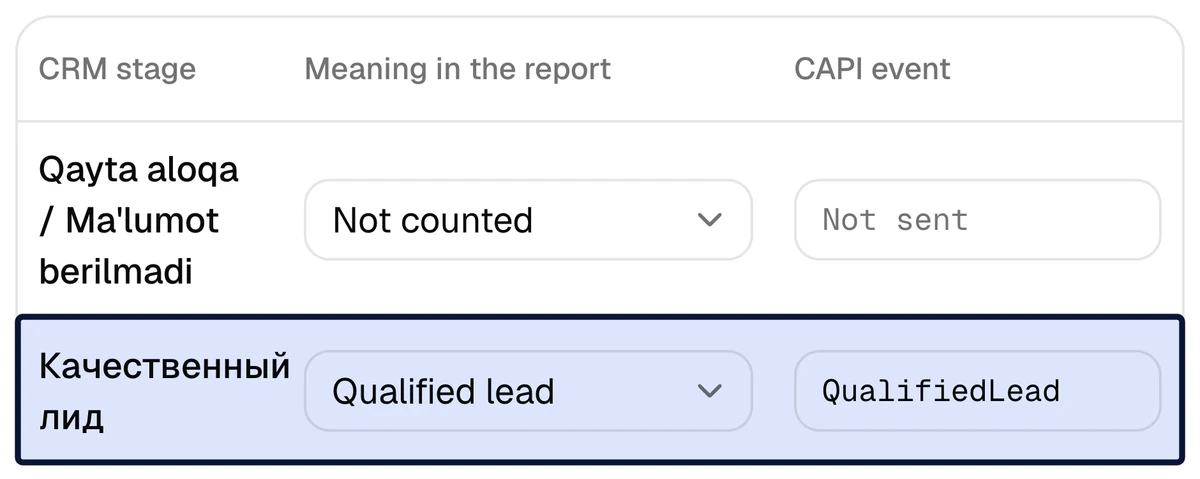
A deal moves from stage to stage in amoCRM, and Meta sees none of it: all it knows is that a form was filled in. On CAPI Platform’s Funnel page every amoCRM pipeline is a table of its stages. Each stage gets two things: its meaning in the report (new lead, qualified lead, sale, junk lead) and, where needed, the event Meta should receive. As soon as amoCRM’s webhook reports a deal entering such a stage, the event is queued and sent.
- The platform makes the first guess: the pipeline’s first open stage is
Lead, its won stage isPurchase. The qualified-lead stage is yours to mark. - Each event is sent once per lead, even if the deal moves back and forth between stages.
- A deal closed straight to a sale sends
QualifiedLeadalong withPurchase. Purchasecarries the deal’s amount, converted to the ad account’s currency. A deal with no amount sends the event without a value.- Deals from before the connection are not sent to Meta: the history is for the report only.
Which stage sends which event? An example pipeline
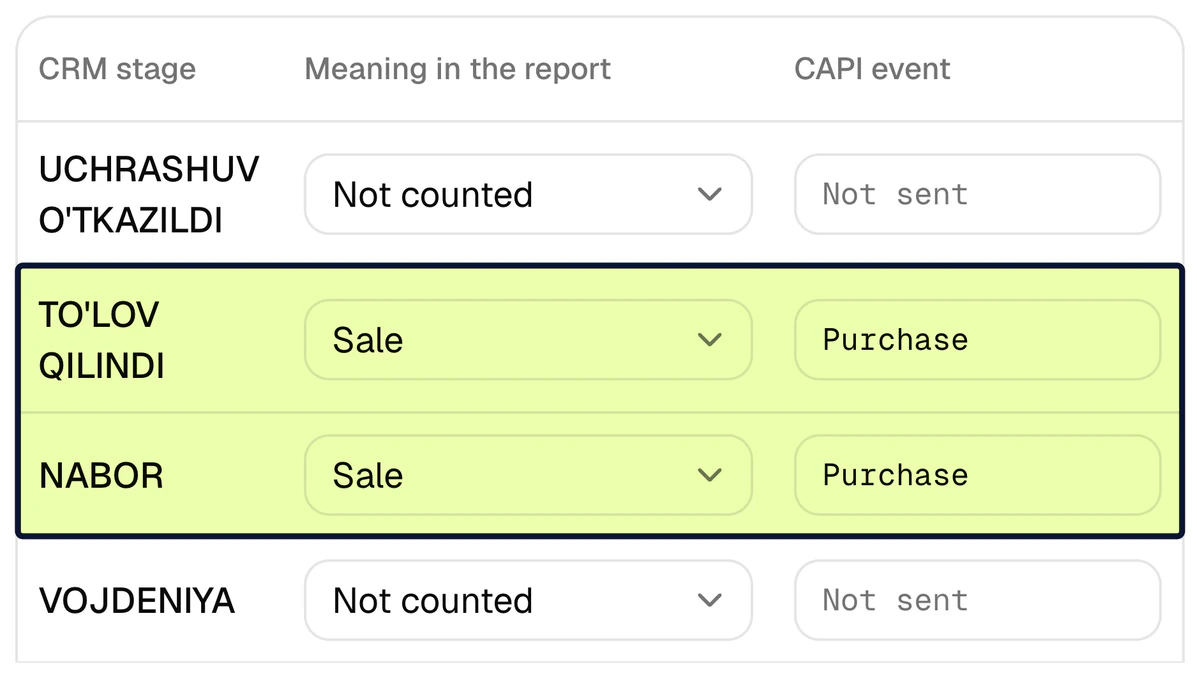
Below is an ordinary amoCRM pipeline and how it is marked. Your stage names will differ; the logic does not. Meta needs three answers: did a lead come, was it a good one, did it buy.
| amoCRM stage | Meaning in the report | Event to Meta |
|---|---|---|
| New request | New lead | Lead |
| Contacted | — | — |
| Meeting booked | Qualified lead | QualifiedLead |
| Awaiting payment | Qualified lead | QualifiedLead — still sent only once per lead |
| Won | Sale | Purchase, with the deal’s amount |
| Not a fit | Junk lead | — |
What goes to Meta with an event: its name and time, SHA-256 hashes of the phone number and e-mail, the Meta lead ID and, where present, Meta’s click identifiers (_fbc, _fbp); for a sale, the amount and currency. Never a name. Phone numbers and e-mails read from amoCRM are kept on the platform only as a hash and a partly masked number.
How does a Facebook or Instagram lead-form lead get into amoCRM?
Someone fills in a lead form (Instant Form) and a deal with a contact appears in amoCRM. The platform takes Meta’s webhook and also checks the form itself every minute, so a lead usually arrives within a minute. Every setting is on the lead delivery page.
A deal and a contact
One lead is one deal with a contact attached. If amoCRM already has a contact with that phone number or e-mail, no second one is made: the deal is attached to the existing contact.
Pipeline, stage, owner
Set per form: which pipeline and stage the lead lands in, who is responsible, how the deal’s name is put together. A finished set-up can be copied from another form.
Which ad it came from
UTM values are written into amoCRM’s UTM fields:
utm_campaignis the campaign name,utm_contentthe ad ID,utm_termthe ad set name. The Meta lead ID and the ad ID go into fields you choose, and the deal gets the “Facebook Lead Ads” tag.The form’s answers
Each answer can be mapped to an amoCRM field, and all answers are also written as a note on the deal. If a field refuses a value, the deal is still created and the answer stays in the note.
No doubles
One Meta lead is one deal: a lead is unique by its Meta ID. Delivery starts from the moment a form is switched on, or from a lead you pick that is at most 3 days old. Switch the old integration off first, or leads arrive twice.
If amoCRM does not answer
Writing is retried at intervals from 1 minute to 24 hours. A lead that has waited 15 minutes raises a Telegram alert. The answers are kept encrypted for 7 days for the retries, then erased.
Website forms do not connect to amoCRM. What else does not work?
That does not drop website leads from the report. If your site writes its requests into amoCRM itself, by whatever means, the platform reads those deals from amoCRM. UTM fields are read automatically: if the ad’s link carries the ad ID in utm_content, the lead is tied to that ad. A stage change then sends its event too.
- Leads from Direct, WhatsApp, Telegram and calls are not tied to an ad automatically. They show in the report by channel, with the reason. The exception: a person who filled in a Meta lead form earlier is tied to that ad by phone number.
- Connecting Instagram Direct conversations to amoCRM is not CAPI Platform’s job: that is set up on the amoCRM (Kommo) side.
- Stages are not mapped by themselves. Which stage means a qualified lead and which a sale is something you mark once — together with us if we do the set-up.
- The webhook is added in amoCRM by hand. The platform cannot register it there; the address and the events to tick are shown on the connection page.
- One project, one CRM. A second business or a second amoCRM account gets its own project.
- Meta only. Google Ads, TikTok and Yandex are not connected.
What does Kommo’s native Meta CAPI integration cover?
amoCRM is sold internationally as Kommo. Kommo’s help centre describes its own Meta Conversions API integration (the article was updated on 19 May 2026). The Kommo column is what that article says; the CAPI Platform column is what the platform does. They solve different tasks.
| Kommo’s native integration, per its documentation | CAPI Platform | |
|---|---|---|
| Which leads | Conversations from Instagram, Messenger and WhatsApp Cloud API sources | Meta lead-form leads; other amoCRM deals that have a phone number, an e-mail or an fbclid |
| Events | Two: Lead and Purchase | Three: Lead, QualifiedLead, Purchase; an event name of your own is possible too |
| What triggers an event | A pipeline stage or Salesbot | A pipeline stage |
| Where the result is seen | In Meta Events Manager | In Events Manager, in the platform’s event log and in the report per creative |
| Lead forms | Kommo takes Facebook lead-form leads in natively — on all plans, per its integration page. The CAPI article does not mention such leads | The lead is written into amoCRM and the events go for that same lead |
| A report with ad spend | Not mentioned in the article | Yes: spend → lead → qualified lead → sale, per creative |
| Price | The article: “Starting June 1, this integration is available on the Pro plan only” | $159 once for the set-up, then $40 a month — pricing |
Sources are at the end of the page; checked on 9 October 2026. Confirm the plan’s name and terms on Kommo’s current pricing page. We have not checked whether amocrm.ru accounts have this integration — look in your own account. If click-to-message ads (Direct, WhatsApp) are your main channel, Kommo’s integration covers exactly that: CAPI Platform does not tie such leads to an ad automatically.
How to connect amoCRM in 6 steps
Three days when we do it: $159 once, then $40 a month (pricing). You give access to amoCRM and to the Meta ad account. If you connect it yourself the order is the same: sign-up is open through Google.
- 1
Get a long-lived token in amoCRM
amoCRM → Settings → Integrations → create a private integration → Keys and scopes → Long-lived token. The platform keeps the token encrypted.
- 2
Connect amoCRM to the project
On the Connections page enter the amoCRM address (for example company.amocrm.ru; amocrm.com and kommo.com addresses are accepted too) and the token. The platform reads the pipelines and stages and loads the last 30 days of history into the report. Old leads are not sent to Meta.
- 3
Add the webhook in amoCRM
amoCRM → Settings → Integrations → Webhooks: add the address the platform shows and tick three events — Lead added, Lead edited, Lead status changed (amoCRM’s interface calls a deal a lead). From then on a stage change reaches the platform at once.
- 4
Connect Meta
A Meta system user token and the Dataset (Pixel) ID. The token must allow reading ad statistics and lead forms; its permissions are checked as you connect.
- 5
Tie stages to events
On the Funnel page mark which stage means a qualified lead and which a sale. It is done once: two or three stages, and the rest runs by itself.
- 6
Send a test event, then switch the lead forms on
The test event proves the token, the dataset and the path with one harmless signal. Each lead form is switched on separately: first look in the preview at how the last 3 real leads would be written into amoCRM — phone numbers masked, nothing saved. If another integration delivers the leads today, switch it off first.
How do you know an event reached Meta?
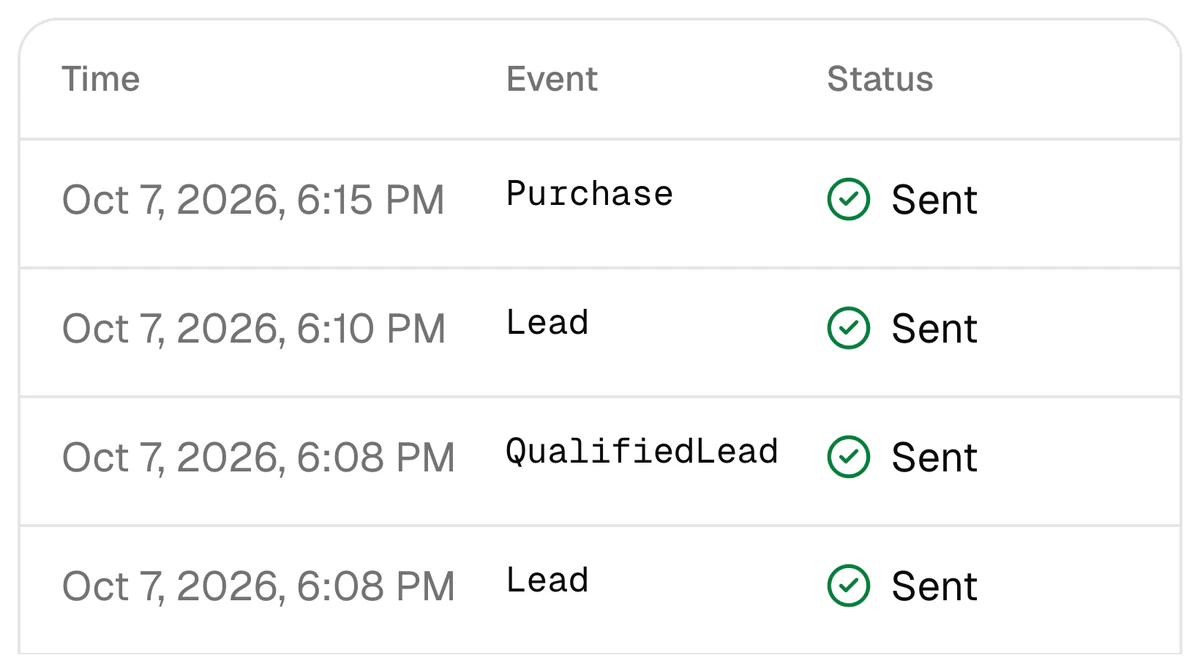
The CAPI events page lists every event sent to Meta: its time, its name and its status — queued, sent, failed or skipped. A failed event is sent again at intervals from 1 minute to 24 hours. The same page keeps a log of the webhooks that came from amoCRM: if stage changes stop arriving, that is the first place to look.
- A deal with no phone number, e-mail, Meta lead ID or fbclid is skipped, with the reason shown beside it.
- If amoCRM goes silent or the connection returns an error, a Telegram alert comes — when problem alerts are switched on.
- There is a field for a test event code: the event then shows in the testing section of Events Manager.
Next to the amoCRM integration
Conversions API
How a CRM outcome goes back to Meta: Lead, QualifiedLead, Purchase.
Lead delivery
A lead form’s settings: fields, preview, the log and retries.
Report per creative
Spend → lead → qualified lead → sale for every creative.
Article: amoCRM and the Conversions API
Sending amoCRM pipeline stages to Meta as events, in detail.
Bitrix24 integration
What differs in Bitrix24: Lead → Deal and website forms.
Pricing
Set-up is $159 once, then $40 a month.
Questions about the amoCRM integration
Can CAPI Platform connect Instagram to amoCRM?
Lead forms of Instagram and Facebook ads — yes: a lead lands in amoCRM as a deal with a contact, and the outcome from the pipeline goes back to Meta as an event. Connecting Instagram Direct conversations to amoCRM is a different task: it is set up on the amoCRM (Kommo) side, and CAPI Platform does not do it.
Do amocrm.ru, amocrm.com and kommo.com accounts all connect?
Yes, all three. A connection takes the account’s address and a long-lived token; the token is created inside a private integration in amoCRM and is kept encrypted on the platform. One project connects one account.
Do website form requests reach amoCRM?
No. The platform’s website forms write into Bitrix24 and capiCRM only. If your site sends its requests into amoCRM itself, the platform reads those deals from amoCRM, ties them to an ad by UTM and sends an event to Meta when the stage changes.
Are old amoCRM deals sent to Meta?
No. On connection the last 30 days of history load into the report only. Events go for deals that enter a marked stage after the connection; anything older than 7 days is not sent at all — Meta does not accept it.
Kommo has its own Meta CAPI integration. Why CAPI Platform?
Per Kommo’s documentation, its integration works for Instagram, Messenger and WhatsApp Cloud API sources and sends two events: Lead and Purchase. CAPI Platform works with lead-form leads, also sends QualifiedLead, and shows the outcome beside ad spend, per creative. If conversations are your main channel, Kommo’s integration fits; if lead forms are, CAPI Platform does.
How long does connecting amoCRM take, and what does it cost?
Three days when we do it: on day 1 amoCRM is connected and 30 days of history load, on day 2 stages are tied to events together with you, on day 3 a test event goes out. Set-up is $159 once (lead integration is included in that price), then $40 a month: the Conversions API, the report, Telegram reports and lead integration up to 4,000 leads a month. More: pricing.
Sources
What is said about Kommo comes from its own pages, checked on 9 October 2026.
Let the sales in amoCRM go back to Meta
Sign up with Google and connect amoCRM and Meta yourself, or leave a request and we will set it up in 3 days. Set-up is $159 once, then $40 a month.