Cheap Facebook leads but no sales: why low-quality leads happen and how to fix them
Sardor Rakhmonkulov7 min read
Cheap leads with no sales usually come from one of three places: the ad attracts people who fill in forms, not buyers; the form is too easy; or sales calls too late. When the only signal Meta receives is a submitted form, it looks for the cheapest form-filler. The fix: judge creatives by qualified leads and sales, not cost per lead, and send CRM outcomes back to Meta.
In short
- Meta multiplies the signal it is given: if that is only a submitted form, it finds people who submit forms.
- Driving school, 2–8 October 2026: one creative brought 79 leads at $0.87 and 0 sales; another, 77 leads at $1.28 and 5 sales.
- In the same week $386 — 44% of the budget — went to 23 creatives without a single sale.
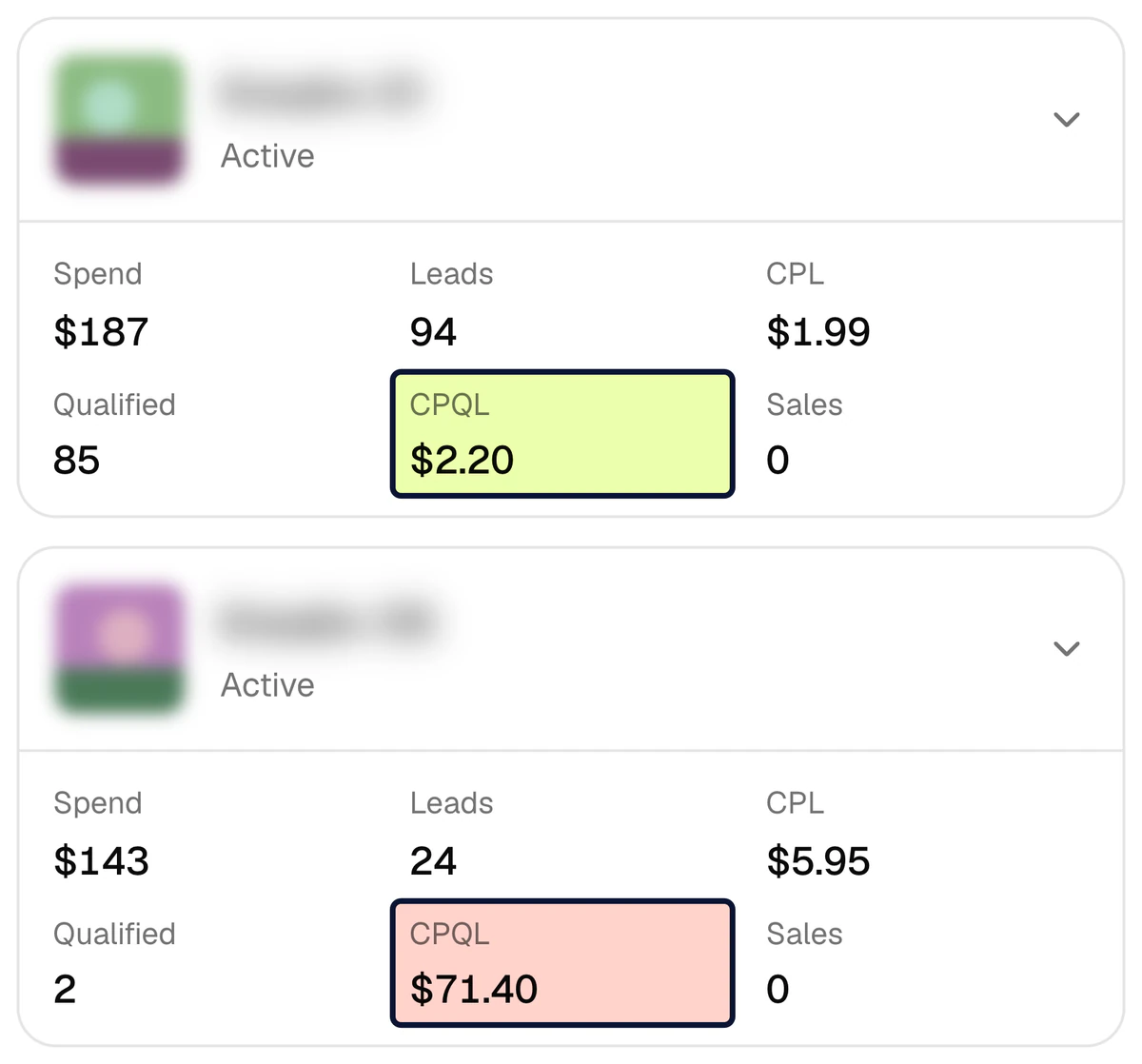
- At a learning centre a qualified lead cost $2.20 in one creative and $71.40 in another: a 32-fold gap.
- The order: measure first, then fix creatives, the form and the calls, and finally send the qualified-lead signal back to Meta.
“Cheap Facebook leads but no sales” is the most common complaint from businesses that run lead ads on Meta (Facebook and Instagram). The media buyer points to a low cost per lead, sales says the leads are junk, and the owner does not know whom to believe. Below: where low-quality leads come from, numbers from real reports, and the fix.
Why is the cheapest lead often the worst one?
In a lead-form campaign Meta knows one outcome: the form was submitted. That is what the algorithm multiplies and makes cheaper: it finds people who fill in forms easily. Whether they pick up the phone or buy, Meta cannot tell — that becomes known in the CRM, after the call.
So the cheapest lead often comes from someone who fills in any form: drawn by a giveaway, merely curious, or unable to remember leaving a request. In Ads Manager that ad looks like the “best” one, and the budget flows towards it. This is not a malfunction: the algorithm was asked for leads, not sales.
A low-quality lead is a person who submitted a form but cannot become a customer: the number is wrong, they do not answer, they say “I never signed up”, or the product does not fit them. A qualified lead is one the sales team has spoken to and confirmed as a real buyer.
Do cheap leads really not buy? 79 leads, 0 sales
One driving school, one week (2–8 October 2026), two creatives. The first brought leads at $0.87 each — on cost per lead it wins. The second creative’s lead cost $1.28 — 47% more. In the CRM the picture is reversed.
| First creative | Second creative | |
|---|---|---|
| Leads | 79 | 77 |
| Cost per lead (CPL) | $0.87 | $1.28 |
| Qualified leads | 21 | 26 |
| Sales | 0 | 5 |
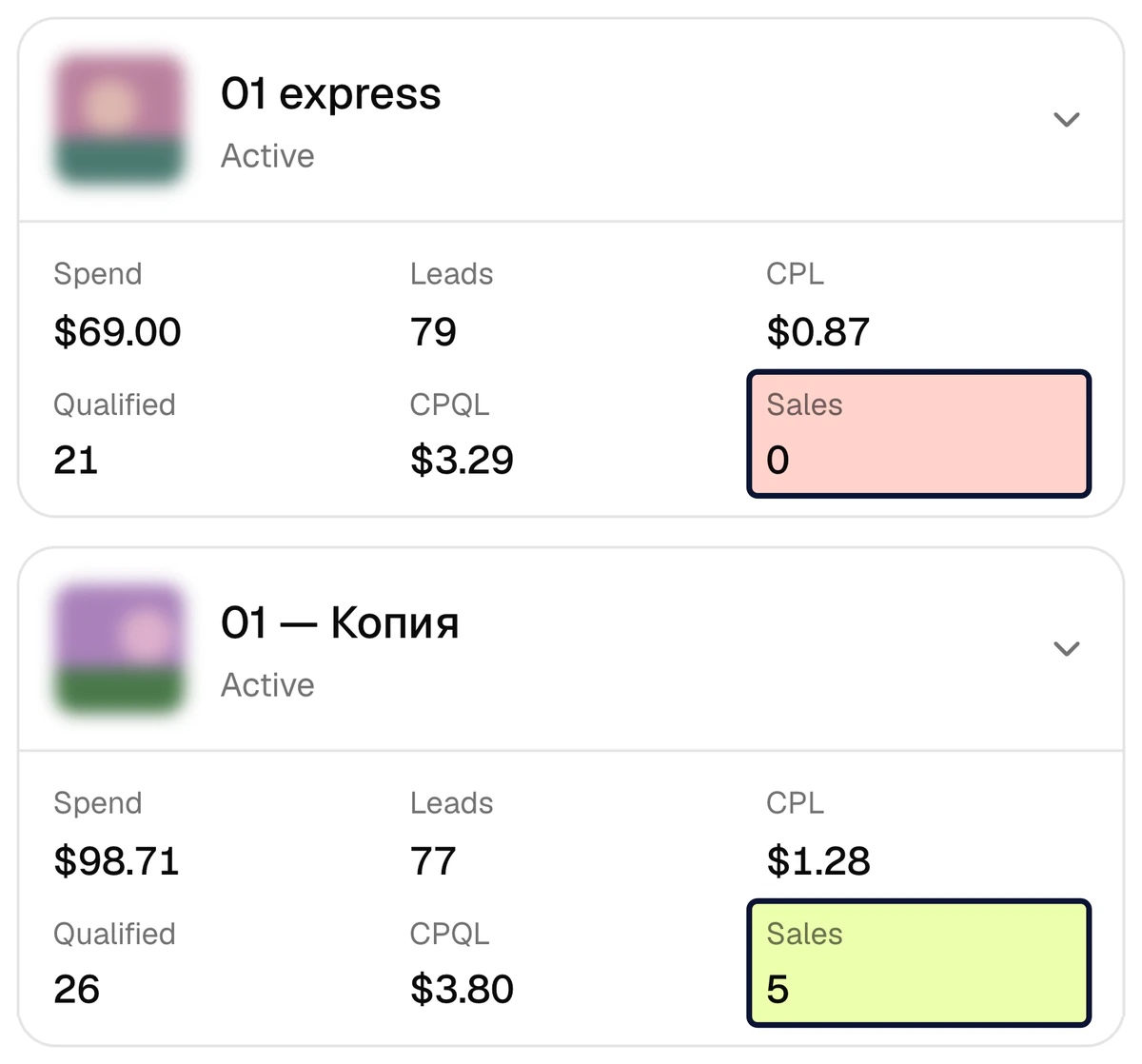
Judged on cost per lead, the first creative would get more budget and the second would be switched off as “expensive”: the ad that sells stops, the one that does not gets more money.
Note that the first creative also has 21 qualified leads: by qualified leads alone it does not look bad. Only sales showed the difference. So check a creative in two steps: qualified leads first, then sales.
- went to creatives with no sale44% of the week’s budget
- $386
- creatives spent money and brought no sale
- 23
- sales in the same weekcustomer acquisition cost (CAC): $24.58
- 36
If the cost per lead is the same, is the quality the same?
No. In a learning centre’s report (2–8 October 2026) two creatives had almost the same cost per lead: $2.79 and $2.97. From the first, none of 14 leads qualified; from the second, 18 of 24 did. In Ads Manager they look identical.
Another pair from the same report: in one creative 85 of 94 leads qualified, at $2.20 per qualified lead. In another, 2 of 24 did, at $71.40 — 32 times more. Of the 685 leads the centre received that week, 134 were junk. Cost per lead says nothing about quality; only the CRM outcome does.
CPQL = ad spend ÷ number of qualified leads
Example: Driving school, 2–8 October 2026: $885 ÷ 335 = $2.64. Cost per lead that week was $1.03, so a qualified lead cost 2.6 times as much, and one customer cost $24.58. More: CPL, CPQL, CAC and ROAS in one funnel.
Why are Facebook leads low quality? Causes in the ad, the form and sales
There is rarely a single cause. Check three places separately: who the ad brings in, who the form lets through, and what sales does with the lead.
| Where | Cause | How it shows |
|---|---|---|
| Ad | The creative sells a gift, a discount or “free”, not the product | Cheap leads, a low share of qualified leads |
| Ad | The audience is too broad, or the city or age is wrong | “I’m in another city”, “it’s not for me” |
| Ad | The campaign is optimised for lead count only | More leads, the same number of sales |
| Form | Two taps to submit: name and phone come prefilled from the profile | “I never signed up”, old or somebody else’s numbers |
| Form | No qualifying question; price and terms are not stated | “Too expensive”, “I was just asking” |
| Sales | A late first call: leads are copied into the CRM by hand or sit in a queue | A new lead is called hours later or the next day |
| Sales | A lead is closed as junk after one call | Most junk leads carry the reason “no answer” |
| Sales | Stages are not kept in the CRM | Nobody knows who qualified and who bought |
How do you tell which side the problem is on?
- Share of qualified leads by creative. If the spread looks like the learning centre’s — 85 of 94 in one creative and 2 of 24 in another — the cause is in the ads.
- Reasons for rejection. A lot of “no answer” points to the form and the speed of the call; a lot of “not a fit” and “too expensive”, to what the creative promises.
- Time to first call. If hours pass between the request and the call, start there.
More on this argument: “the leads are junk” or “sales isn’t working them”.
How do you fix low-quality leads? Seven steps
- 1
Mark two stages in the CRM
Agree with sales which stage means “qualified lead” and which means “sale”; junk leads need a stage of their own. Without this there is nothing to measure.
- 2
Sort creatives by qualified leads and sales
Once a week, put the CRM outcome next to each creative: leads, qualified leads, CPQL, sales. By hand that is a CRM export and a spreadsheet; in the CAPI Platform report it is one table.
- 3
Pause creatives that bring no qualified leads
Move the budget to the ones that sell. But do not judge a new creative by its first week’s sales: its leads are still on the way. Look at qualified leads first; check sales once your sales cycle has passed.
- 4
Say in the creative who it is for and what it costs
State the price, terms, location and intended customer in the ad itself: the lead gets dearer, but people it does not suit stop filling in the form. Do not collect leads with gifts and the word “free”.
- 5
Make the form a little harder
Add one or two qualifying questions: when they plan to start, which branch suits them. Switch on the form type with a review screen before submission (Higher intent in Ads Manager). Fewer leads will come; that is the point.
- 6
Get the lead into the CRM at once and call fast
Do not copy leads from a spreadsheet by hand: lead delivery puts a Meta form lead into the CRM in about a minute, with every answer. Call several times, not once, and record the outcome as a stage. In capiCRM a new lead can automatically get the task “call within 15 minutes”.
- 7
Send the qualified-lead signal back to Meta
When a lead reaches the “qualified” stage in the CRM, a
QualifiedLeadevent goes to Meta; on a sale,Purchase. The Conversions API does this. Then create a custom conversion fromQualifiedLeadin Ads Manager and optimise the campaign for it.
What changes when the signal goes back to Meta?
Without a signal Meta looks for people who fill in forms; with one, for people like those who turned out qualified and bought. Meta reports that in instant-form campaigns with the CRM connected through the Conversions API and optimised for the number of qualified leads, the cost per quality lead was 19% lower on average (a budget-controlled A/B test, 567 advertisers, 13–27 January 2025). That is Meta’s test: not a CAPI Platform result, and not a promise.
In CAPI Platform the stages that mean a qualified lead and a sale are marked once on the Funnel page. As soon as a lead in Bitrix24, amoCRM (Kommo) or capiCRM enters such a stage, the event goes to Meta by itself; the log shows every signal and its status: queued, sent or failed. Phone and e-mail are sent only as SHA-256 hashes; names are never sent. Old leads are not sent to Meta.
See which of your ads sell, in your own numbers
CAPI Platform connects Meta ads with Bitrix24, amoCRM (Kommo) or capiCRM: a report by creative, plus qualified-lead and sale signals. Set-up is $159 once (3 days), then $40 a month.
FAQ
What is a good cost per lead?
There is no single norm: it depends on the industry, the product’s price and the form. Compare cost per qualified lead (CPQL) and customer acquisition cost (CAC) rather than cost per lead. In one week at the driving school (2–8 October 2026) a lead cost $1.03, a qualified lead $2.64 and a customer $24.58.
Should I turn off a creative with cheap leads straight away?
No. First see how many of its leads became qualified and how many bought. Cheap does not mean bad: at the learning centre one creative had 85 qualified leads out of 94, at $2.20 per qualified lead. The creative to turn off is the one that spends money and brings neither qualified leads nor sales.
Low-quality leads: is the media buyer or the sales team to blame?
Look at the numbers. If the share of qualified leads differs sharply from creative to creative, the cause is in the ads. If it is low everywhere and the main rejection reason is “no answer”, look at the form and the speed of the first call. Usually it is some of both.
How many leads a month do I need to optimise for qualified leads?
Meta’s developer documentation says at least 200 leads a month and a target stage that 1–40% of leads reach within 28 days. Meta’s newer marketing page says there is no minimum volume and 200+ is only a recommendation. With few leads the report by creative still works: you can see which ad sells without any optimisation.
We have no CRM and keep leads in a spreadsheet. Where do we start?
Without stages quality cannot be measured, so a CRM comes first. CAPI Platform has its own, capiCRM: Meta form leads land in it by themselves, and a stage change goes straight to the report and to Meta as a signal. Bitrix24 and amoCRM (Kommo) can be connected too.
How much does CAPI Platform cost?
Set-up is $159 once: in 3 days the CRM is connected, stages are tied to signals and a test signal is sent. Then $40 a month: the Conversions API signals, the report, Telegram reports and lead integration up to 4,000 leads a month.
Sources
- 1Conversions API for CRM — Meta
- 2Conversion Leads integration — Meta for Developers
Read next
- Lead quality
How to optimize Meta lead ads for qualified leads, not lead volume
Moving a Meta campaign from lead volume to qualified leads: the stage, the custom conversion, signal volume, the numbers.
8 min read
- Lead quality
Sales says the leads are bad, marketing says they’re fine: how to settle it with numbers
“The leads are junk” versus “sales isn’t working them”: the numbers that make both right, and six steps for the first week.
7 min read
- Creative analysis
Which ad creative actually drives sales? Reading a Meta ads report by sales, not cost per lead
Reading a per-creative table by sales: a real pair (79 leads, 0 sales vs 77 leads, 5 sales), a waiting rule and a weekly routine.
7 min read