How to evaluate a media buyer’s Meta ads report: what it must contain, with a worked week
Sardor Rakhmonkulov7 min read
Evaluate a media buyer by CRM outcomes, not by cost per lead. A Meta ads report should show, for every creative, spend, leads, qualified leads and their cost (CPQL), sales and cost per customer (CAC). In one week at a driving school, a creative with $0.87 leads made no sales, while one with $1.28 leads made five. A report that stops at cost per lead cannot show that.
In short
- Cost per lead is where a report starts, not where it ends: qualified leads, sales and cost per customer come from the CRM.
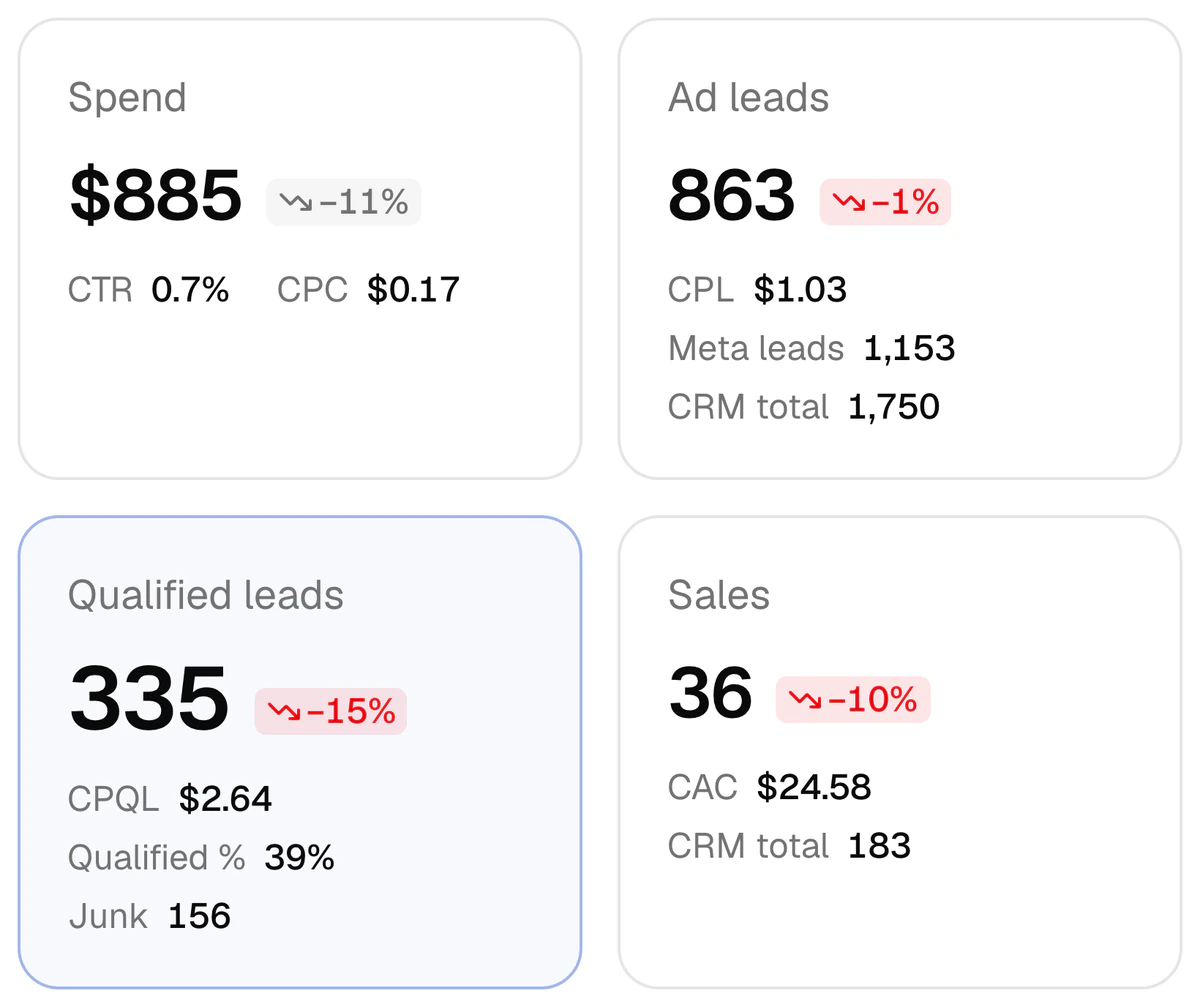
- A driving school, 2–8 October 2026: $885 of spend → 863 leads ($1.03) → 335 qualified leads ($2.64) → 36 sales ($24.58).
- In the same week 23 creatives spent $386, 44% of the budget, without a single sale: only a per-creative view shows it.
- Warning signs: the report gives only cost per lead, has no CRM numbers and no breakdown by creative.
- A media buyer answers for whom the ads bring in and at what cost (CPQL); taking a qualified lead to a sale is the sales team’s work.
How do you evaluate a media buyer’s Meta ads report when you do not work in Ads Manager? Most owners look at cost per lead: cheap is good, expensive is bad. But it measures only the first step: someone submitted a form. Whether that person is a buyer, it does not say.
Below: what the report must contain, what to ask each week and the warning signs. The worked example is one real week: a driving school advertising on Meta (Facebook and Instagram), 2–8 October 2026. In Uzbekistan and the CIS the role is called a targetologist. The checklist is no trap: a good media buyer wants to show these numbers.
What should a media buyer’s Meta ads report contain?
A media buyer’s report should contain seven things: spend, leads with cost per lead, qualified leads, cost per qualified lead, sales with cost per customer, revenue — all of it broken down by creative. The first two come from the ad account, the rest from the CRM.
| Metric | Where it comes from | What good looks like |
|---|---|---|
| Spend | Meta ad account (Ads Manager) | Within the agreed budget, no sudden jumps between days |
| Leads and cost per lead (CPL) | Ads Manager counts submitted forms; the CRM counts records | Close to your own previous weeks. A cheap lead is not yet a result |
| Qualified leads and their share | CRM: a sales manager moves the lead to the “qualified” stage | The share holds or grows. No universal norm: compare with your own earlier weeks |
| Cost per qualified lead (CPQL) | Spend from Meta, qualified leads from the CRM | This number, not CPL, holds or falls. The main figure for judging a media buyer |
| Sales and cost per customer (CAC) | CRM: the deal reaches the sale stage | CAC is below the profit one customer brings |
| Revenue and ROAS | CRM: the amount entered in the deal | ROAS above 1 ÷ margin (above 2× at a 50% margin). Sales without an amount are flagged |
| Breakdown by creative | The ad in Meta and the CRM lead tied to it | Each creative shows its qualified leads and sales; those that spend without results are paused |
Formulas with a full calculation: CPL, CPQL, CAC and ROAS. Here one is enough: the fairest measure of a media buyer’s work.
CPQL = ad spend ÷ number of qualified leads
Example: Driving school, 2–8 October 2026: $885 ÷ 335 qualified leads = $2.64. Cost per lead in the same week: $1.03.
A qualified lead is a lead the sales team has spoken to and confirmed as a real prospect: in the CRM it has reached the stage that means so. Owner, media buyer and sales agree once which stage that is.
Which warning signs should you look for in the report?
Five signs say a report is incomplete. They do not prove the media buyer works badly: often nobody gave them the CRM numbers. But the work cannot be judged that way.
- Only cost per lead is reported. “863 leads at $1.03” is true and says nothing about who the leads are. CPL can also fall at the expense of quality: the easier the form, the more accidental submissions.
- No CRM numbers. With no qualified leads, sales or revenue, the ad report is cut off from the CRM. Ask first: can your media buyer see CRM outcomes at all?
- No per-creative view. An average blends the creative that sells with the one that does not. You cannot see which ad was paused, or why.
- Reach, clicks and CTR in place of results. A media buyer’s working numbers: needed for tuning ads, not a business outcome.
- No comparison with the previous period. A weak week belongs in the report too, with its cause and the next step.
How do you read a weekly report? A worked example
The driving school, 2–8 October 2026. The usual report would read: “$885 spent, 863 leads, cost per lead $1.03.” All true, and it looks fine. Now add that week’s CRM numbers.
| Ad account only | With the CRM | |
|---|---|---|
| Overall | 863 leads at $1.03 | 335 qualified leads (39%), CPQL $2.64; 36 sales, CAC $24.58 |
| First creative | 79 leads at $0.87 — the “best” ad | 0 sales |
| Second creative | 77 leads at $1.28 — 47% dearer | 26 qualified leads, 5 sales |
| Budget | $885 spent | $386 (44%) went to 23 creatives with no sale |
| Revenue | Not visible | $5,297 recorded in the CRM, ROAS 5.99× |
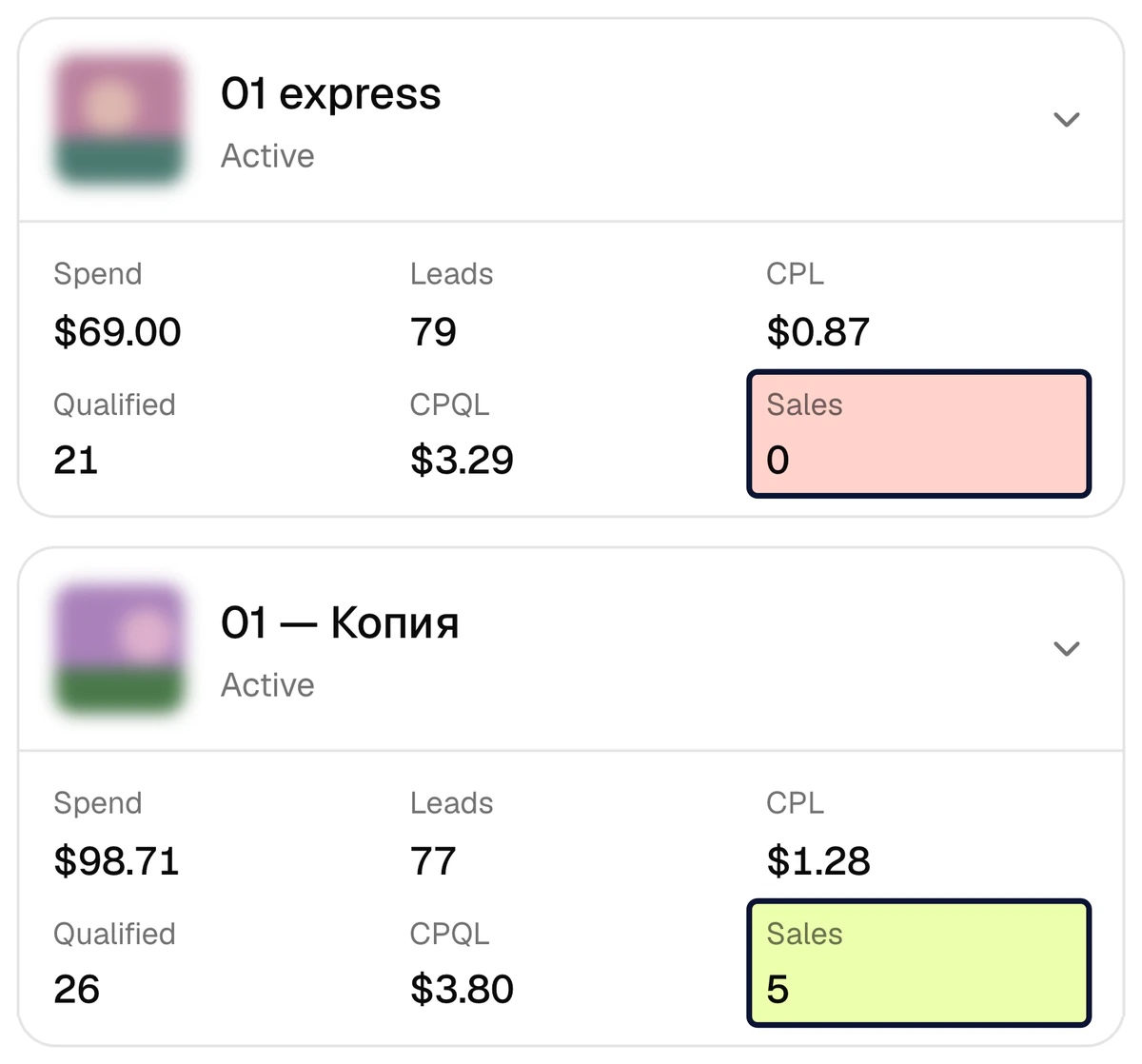
Someone who looks only at cost per lead adds budget to the first creative and switches off the second — the ad that sells. This is not the media buyer’s fault: without the sales figure they decide on the only number they have.
The revenue is what sales managers entered in the CRM: at this school about half of the amounts get entered, so 5.99× is ROAS on recorded revenue. Ask how many sales carry no amount.
What should you ask your media buyer every week?
Six questions are enough. A good answer has a number, a reason and a next step.
- 1
How many qualified leads came in, and at what cost?
The answer gives qualified leads, their share and CPQL against the week before — not the lead count. If the week was weak, it names the reason.
- 2
Which creatives spent money and brought no qualified leads?
A list and a decision: paused, or why it still runs. The driving school’s week: 23 creatives spent $386 without a single sale.
- 3
Which creative brought sales?
Did it get more budget? Is a similar creative in the works?
- 4
Does the lead count in Ads Manager match the CRM?
Ads Manager counts submitted forms; the CRM counts records. A large gap means leads get lost on the way or duplicated: find the cause.
- 5
Is Meta told what happened in the CRM?
On its own, Meta saw 863 leads that week and none of the 36 sales. When outcomes go back through the Conversions API, a campaign can be optimised for qualified leads. Meta reports a 19% lower cost per quality lead on average for advertisers who used the Conversions API for CRM and optimised instant forms for qualified leads (budget-controlled A/B test, 567 advertisers, 13–27 January 2025). That is Meta’s test, not a CAPI Platform result.
- 6
What will be tested next week?
A new creative, offer or audience — and the number it will be judged by. A report with no plan only sums up last week.
What is fair to expect from a media buyer, and what belongs to sales?
A media buyer answers for whom the ads bring in and at what cost. What happens to that person next is the sales team’s work. The line runs through the qualified lead: before it the question goes to advertising, after it to sales.
| Who | Answers for | Where it shows |
|---|---|---|
| Media buyer | Creatives, audiences, the form, splitting the budget between creatives, pausing ads that do not work | Cost per lead, qualified share and CPQL, per creative |
| Sales team | Calling a lead fast, moving the CRM stage on time, taking a qualified lead to a sale, entering the deal amount | Conversion from qualified lead to sale (that week: 36 against 335, or 11%); sales with no amount |
| Business owner | Product, price, offer and budget; agreeing what “qualified lead” means; letting the media buyer see CRM outcomes | CAC and ROAS |
So a sales-only KPI for a media buyer is unfair: a sale depends on the ads and on the sales team. A fair measure is qualified leads and CPQL. If the qualified share drops, ask advertising; if qualified leads are plenty and sales few, ask sales. More on that argument: “the leads are junk” or “sales isn’t working them”.
The other side: you cannot demand qualified leads from a media buyer who never sees CRM outcomes. They need numbers, not contacts. If you are the media buyer, see the page for media buyers on showing these numbers to a client.
Where do you get a report like this?
You can build it by hand: spend per ad from Ads Manager, leads with stage and amount from the CRM. The hard part is tying each lead to its ad: the CRM needs the Meta lead ID, or the ad ID in the ad link’s UTM tags. And it repeats every week.
The CAPI Platform report does that matching: Meta spend and the outcome from Bitrix24, amoCRM or capiCRM stand in one row per creative. A summary arrives in Telegram daily, weekly or monthly; in a group chat the owner, the media buyer and the head of sales see the same numbers.
Look at one report together with your media buyer
CAPI Platform shows spend → lead → qualified lead → sale for every creative. Sign up with Google and connect Meta and your CRM yourself — or leave a request and we will connect it in 3 days. Set-up is $159 once, then $40 a month.
FAQ
How often should a media buyer report?
Weekly, with numbers and decisions; monthly, with conclusions and a plan for the next month. A short daily summary does not have to be written by hand: it can be sent automatically. CAPI Platform sends the report to Telegram daily, weekly or monthly, at an hour you choose.
Should a media buyer’s KPI be sales?
Not as the only KPI: a sale also depends on how fast the sales team calls, on the price and on the product. A fair KPI for a media buyer is the number of qualified leads and cost per qualified lead (CPQL). Watch sales and CAC together: that responsibility is shared.
If leads are cheap, is the media buyer doing a good job?
Not necessarily. In one week at a driving school a creative with $0.87 leads brought 79 leads and no sales, while one with $1.28 leads made 5 sales from 77 leads. At a learning centre a qualified lead cost $2.20 in one creative and $71.40 in another. Always ask for cost per qualified lead next to cost per lead.
Should I give my media buyer access to the CRM?
They need outcomes, not customer contacts: how many leads proved qualified, how many sales there were and which ad they came from. You can grant access in the CRM itself or share one report. CAPI Platform keeps phones from an outside CRM (Bitrix24, amoCRM) only as a hash and a masked number: the report has the counts, not the full phone numbers.
Who should own the ad account?
The business. Keep the ad account, the Page and the Pixel in your own business portfolio (Business Manager) and give the media buyer access. If you change media buyers, the ad history, audiences and collected data stay with you, and you can check any report against the account yourself.
Sources
- 1Conversions API for CRM — Meta
Read next
- Metrics
CPL vs CPQL vs CAC vs ROAS: four formulas, one funnel, a worked example
Four metrics, four formulas and one real week: $885 of spend → 863 leads → 335 qualified leads → 36 sales.
7 min read
- Lead quality
Sales says the leads are bad, marketing says they’re fine: how to settle it with numbers
“The leads are junk” versus “sales isn’t working them”: the numbers that make both right, and six steps for the first week.
7 min read
- Creative analysis
Which ad creative actually drives sales? Reading a Meta ads report by sales, not cost per lead
Reading a per-creative table by sales: a real pair (79 leads, 0 sales vs 77 leads, 5 sales), a waiting rule and a weekly routine.
7 min read