Sales says the leads are bad, marketing says they’re fine: how to settle it with numbers
Sardor Rakhmonkulov7 min read
When sales says the leads are bad and marketing says they are fine, both are usually right: they read different numbers from one week. At one learning centre 685 leads came at $3.61 each, and 134 were junk. Three things end the argument: one definition of a qualified lead both sides accept (a CRM stage), a weekly table everyone reads, and that stage sent to Meta as a signal.
In short
- Learning centre, 2–8 October 2026: 685 leads at $3.61 each, 134 of them junk — marketing and sales are both right.
- The average cost per lead hides the split: a qualified lead cost $2.20 in one creative and $71.40 in another.
- A “qualified lead” is not an opinion but one CRM stage: sales proposes it, marketing accepts it.
- Once a week everyone reads one table: leads, qualified leads, junk leads and sales for each creative.
- The same stage goes to Meta as a
QualifiedLeadsignal, so Meta hears about lead quality too.
Sales says the leads are bad. Marketing says the leads are fine — sales just isn’t working them. Almost every business that takes leads from Meta (Facebook and Instagram) ads has this argument, and the louder side usually wins. Below: the numbers that make both sides right, and a plan for the first week.
- Head of salesThis week’s leads are junk again. They don’t pick up, and the ones who do say “I never signed up”.
- Media buyer685 leads this week at $3.61 each. The ad account looks fine.
- Head of salesWe closed 134 of the 685 as junk. That is my managers’ whole day.
- Media buyerAnd the rest? Are the leads being called on time?
- OwnerYou are both quoting numbers. I need one answer: which ad sells?
Sales says the leads are bad, marketing says they are fine: who is right?
Both. One week at a learning centre (2–8 October 2026): $2,470 of ad spend, 685 leads, $3.61 per lead. The media buyer quotes that number, and it is correct. Of those 685 leads, 134 were junk — almost one in five. Sales quotes that, and it is correct too.
| Who | What they say | The number they read | What stays out of sight |
|---|---|---|---|
| Marketing | “Leads are cheap, the plan is met” | 685 leads at $3.61 | How many are buyers: the Ads Manager report stops at the lead |
| Sales | “The leads are bad” | 134 junk leads | That 330 leads qualified (48%), and which ads the junk came from |
| Owner | “Money goes out, sales are few” | $2,470 spent, 18 sales | Which creative the money is stuck in |
The media buyer’s report ends at the submitted form. A sales manager talks to every lead but often does not know which ad it came from. So the argument runs on impressions: neither “the leads are bad” nor “sales is lazy” can be checked.
Why does one week produce two opposite verdicts?
Because an average hides the split. Inside the $3.61 average sit two kinds of ads: those that bring buyers and those that bring people who simply fill in forms.
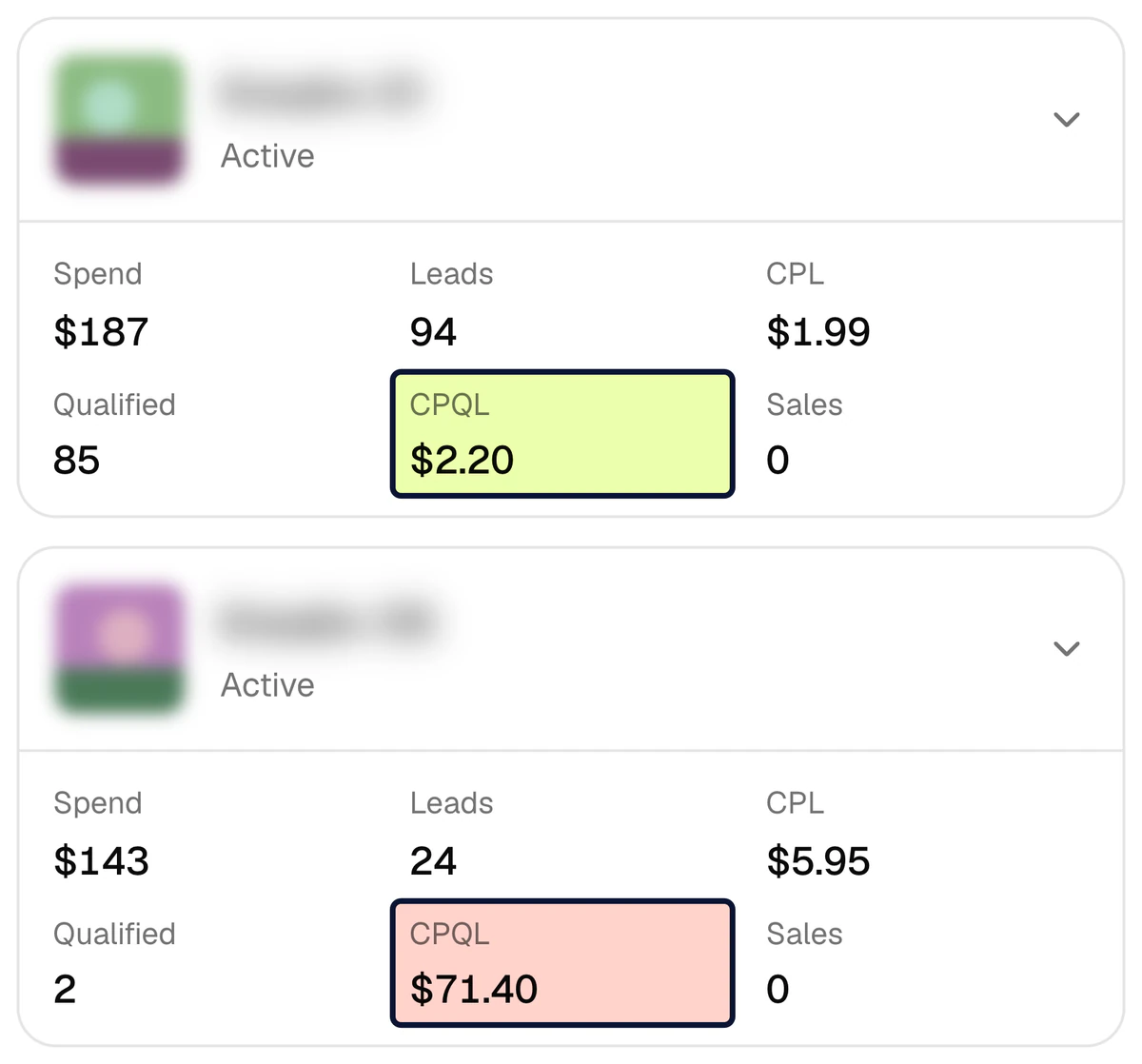
Two creatives from the same report. In one, 85 of 94 leads qualified, at $2.20 per qualified lead. In the other, 2 of 24 did, at $71.40. The gap is 32-fold. In Ads Manager both are just “a lead”.
Another pair has almost the same cost per lead: $2.79 and $2.97. From the first creative none of 14 leads qualified; from the second, 18 of 24 did. The manager who got the first creative’s leads says “they are all junk” — and from where they sit, that is true.
What is a qualified lead, and who decides?
A qualified lead is a lead the sales team has spoken to, confirmed as a real buyer and moved to an agreed stage in the CRM. The definition is a stage, not an opinion: marketing and sales both read from the CRM whether a lead reached it.
Sales proposes the definition, because sales talks to the lead. Marketing accepts it, because it will now be judged on that number. A good definition is:
- A fact from the conversation, not a judgement. “Seemed interested” is a judgement. For a learning centre a fact could be “learned the price and booked a trial lesson”.
- One specific stage. The CRM has a “qualified lead” stage; every working stage after it counts as qualified too.
- A separate stage and a reason for junk. “No answer”, “wrong number”, “not a fit”. Without a reason nobody learns what was wrong with the 134 junk leads.
- A stage leads reach fast. In days, not months — otherwise the weekly table stays empty.
- Unchanged mid-month. If the definition moves, weeks cannot be compared.
Qualified % = qualified leads ÷ leads × 100
Example: Learning centre, 2–8 October 2026: 330 ÷ 685 × 100 = 48%. Cost per qualified lead (CPQL) that week was $7.49, about twice the cost per lead ($3.61). All four metrics in one funnel: CPL, CPQL, CAC and ROAS.
How do you end the marketing vs sales argument over lead quality?
With three things, in this order: one definition, one table, one signal.
- One definition. A “qualified lead” is one CRM stage that both sides accept.
- One table. Once a week the media buyer, the head of sales and the owner read the same table, creative by creative.
- One signal. The same stage goes to Meta:
QualifiedLeadwhen a lead qualifies,Purchaseon a sale.
What should the weekly table show?
One row per creative: spend, leads, qualified leads, qualified %, cost per qualified lead, junk leads and sales. By hand that is two exports, from the CRM and from Ads Manager, merged every week. The CAPI Platform report keeps them in one table, and the weekly report arrives in a Telegram group on the day and hour you choose, so both teams read the same numbers.
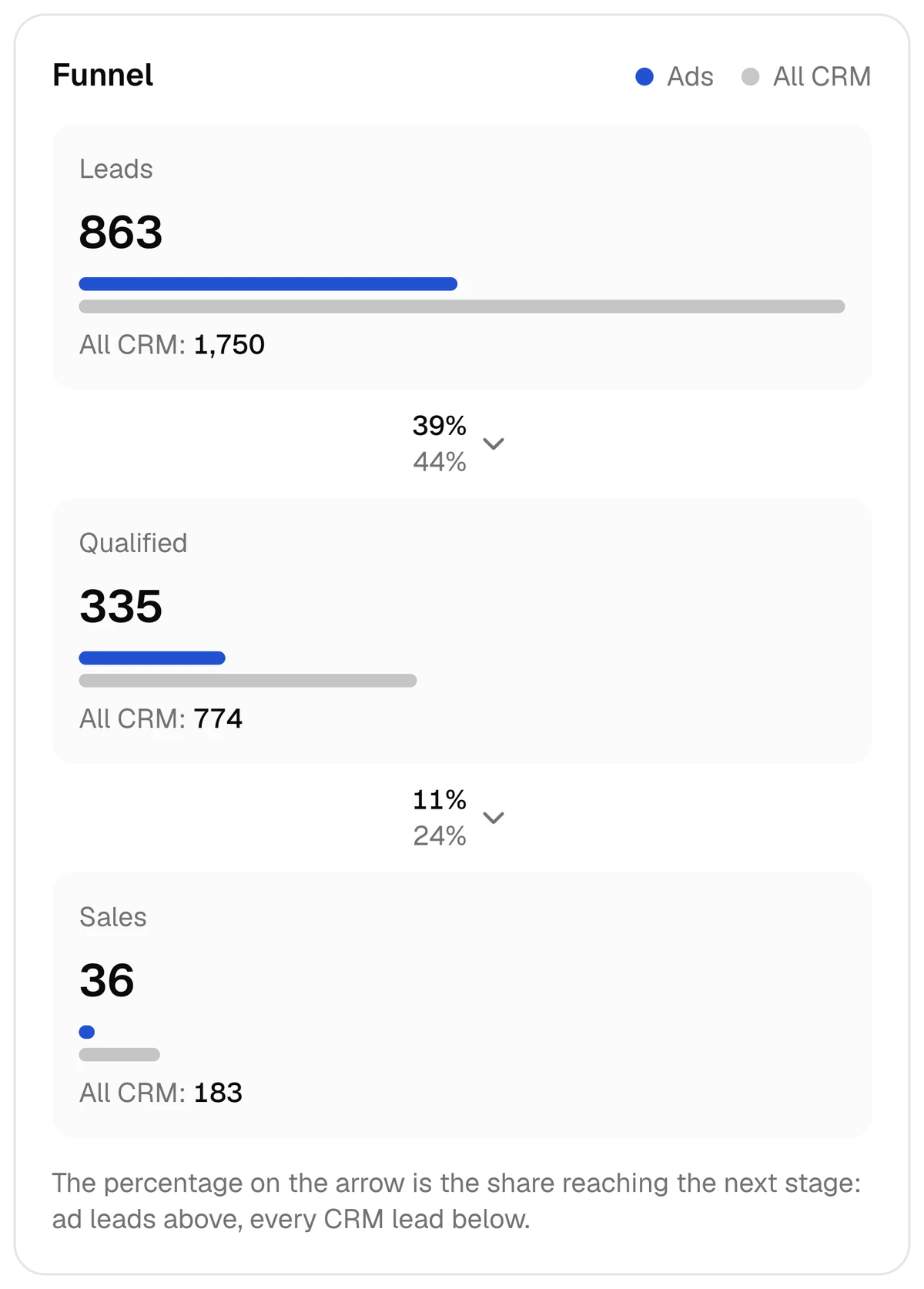
The funnel holds two percentages, each a separate question. At the driving school 39% of leads qualified, and 11% of the qualified leads became sales. The first is about the ad, the form and the first call; the second, about the sales team alone. The question is no longer “who is to blame” but “which number do we fix”.
| What the table shows | Whose question | What to check |
|---|---|---|
| Qualified % differs sharply from creative to creative | Marketing | Who each creative brings in; pause the one with no qualified leads |
| Qualified % is low in every creative; the main reason is “no answer” | Both | Whether the form is too easy; how soon the lead gets the first call |
| Many qualified leads, few sales | Sales | The stages after qualification: meeting, proposal, payment |
| Fewer leads, qualified leads and sales unchanged | Nobody | Set targets by qualified leads and their cost, not by lead count |
What changes when the same stage is sent to Meta as a signal?
Meta is a party to the argument too: it sees the same number marketing does, a submitted form. Until somebody tells it about qualified leads, it keeps looking for people who fill in forms, and the sales team’s complaint returns next week.
The Conversions API carries the definition to Meta: when a lead moves to the “qualified” stage in the CRM, a QualifiedLead event goes out; on a sale, Purchase. In CAPI Platform each stage’s meaning is set once on the Funnel page; the event then goes out as soon as the stage changes in Bitrix24, amoCRM or capiCRM. Phones and e-mails go only as SHA-256 hashes; names are never sent.
Meta reports that lead-form campaigns with the CRM connected through the Conversions API and optimised for the number of qualified leads saw a 19% lower cost per quality lead on average (a budget-controlled A/B test, 567 advertisers, 13–27 January 2025). That is Meta’s test — not a CAPI Platform result and not a promise.
What should you do in the first week?
- 1
Write the definition in one sentence
The head of sales, the media buyer and the owner, one short meeting. The outcome: one sentence, “a qualified lead is…”, and the CRM stage that matches it. Do not leave until all three agree.
- 2
Tidy up three stages in the CRM
Qualified lead, sale and junk lead — with a reason. In Bitrix24 and amoCRM use the stages you already have. With no CRM, capiCRM comes with “Good lead” and “Junk lead” stages ready.
- 3
Agree how stages are kept
Stages are set on the day of the conversation. Write down how many calls a lead gets before it is closed as junk. Without this rule nobody trusts the table.
- 4
Read the table together at the end of the week
One screen, three people, creative by creative. You discuss a row, not an opinion.
- 5
Take one decision from each side
Marketing pauses the creative that brings no qualified leads. Sales fixes the one spot the table pointed at, such as the time to first call. Next week’s table shows the result. Do not judge a new creative by its first week’s sales: its leads are still on the way.
- 6
Connect the signal to Meta
Once the definition works and both sides trust it, switch on the
QualifiedLeadandPurchasesignals. That is day two of a CAPI Platform set-up: stages are tied to signals together with the client.
Settle the argument with your own numbers
CAPI Platform connects Meta ads with Bitrix24, amoCRM or capiCRM: leads, qualified leads and sales per creative in one table, and the qualified-lead signal sent back to Meta. Set-up is $159 once (3 days), then $40 a month.
FAQ
If leads are low quality, is it marketing’s fault or the sales team’s?
Look at the qualified share by creative. At the learning centre 85 of 94 leads qualified in one creative and 2 of 24 in another: a gap like that points to the ads. If the share is low in every creative and leads are being closed as “no answer”, check the form and the speed of the first call. Most often both sides have something to fix.
Who should define a qualified lead?
Sales proposes it, because sales talks to the lead. Marketing accepts it, because it is judged on that number. The owner signs it off. The definition has to be a CRM stage: a spoken agreement is forgotten within a month, while a stage stays in the report.
What if the sales team does not keep stages in the CRM?
Then there is nothing to measure and the argument goes on: the report shows neither qualified nor junk leads, and no signal reaches Meta. Make stage-keeping a working rule: a lead is moved on the day of the conversation. In capiCRM you can switch on an automatic task for every new lead — “call within 15 minutes” — and Telegram reminds people of tasks that are due.
Should marketing be judged on lead count or on qualified leads?
On the number and cost of qualified leads (CPQL); sales, on how many qualified leads became sales. With a lead-count target the media buyer brings the cheapest leads and the argument starts again. In the learning centre’s week a lead cost $3.61 and a qualified lead $7.49 — the second number makes sense to both sides.
Which CRM and which ad platform does this need?
CAPI Platform works with Bitrix24, amoCRM and its own CRM, capiCRM. The only ad platform is Meta (Facebook and Instagram). Leads from Meta lead forms land in the CRM on their own, each tied to its exact ad, so you can see which creative a junk lead came from.
How much does CAPI Platform cost?
Set-up is $159, paid once: in 3 days the CRM is connected, stages are tied to signals and a test signal is sent. Then $40 a month: CAPI, the report, Telegram reports and lead integration for up to 4,000 leads a month.
Sources
- 1Conversions API for CRM — Meta
Read next
- Lead quality
Cheap Facebook leads but no sales: why low-quality leads happen and how to fix them
Why a cheap lead does not sell: two creatives from a real report, causes on three sides and a seven-step fix.
7 min read
- Lead quality
How to optimize Meta lead ads for qualified leads, not lead volume
Moving a Meta campaign from lead volume to qualified leads: the stage, the custom conversion, signal volume, the numbers.
8 min read
- Reporting
How to evaluate a media buyer’s Meta ads report: what it must contain, with a worked week
What the report must contain, what to ask every week and what is fair to expect from a media buyer, shown on one real week.
7 min read